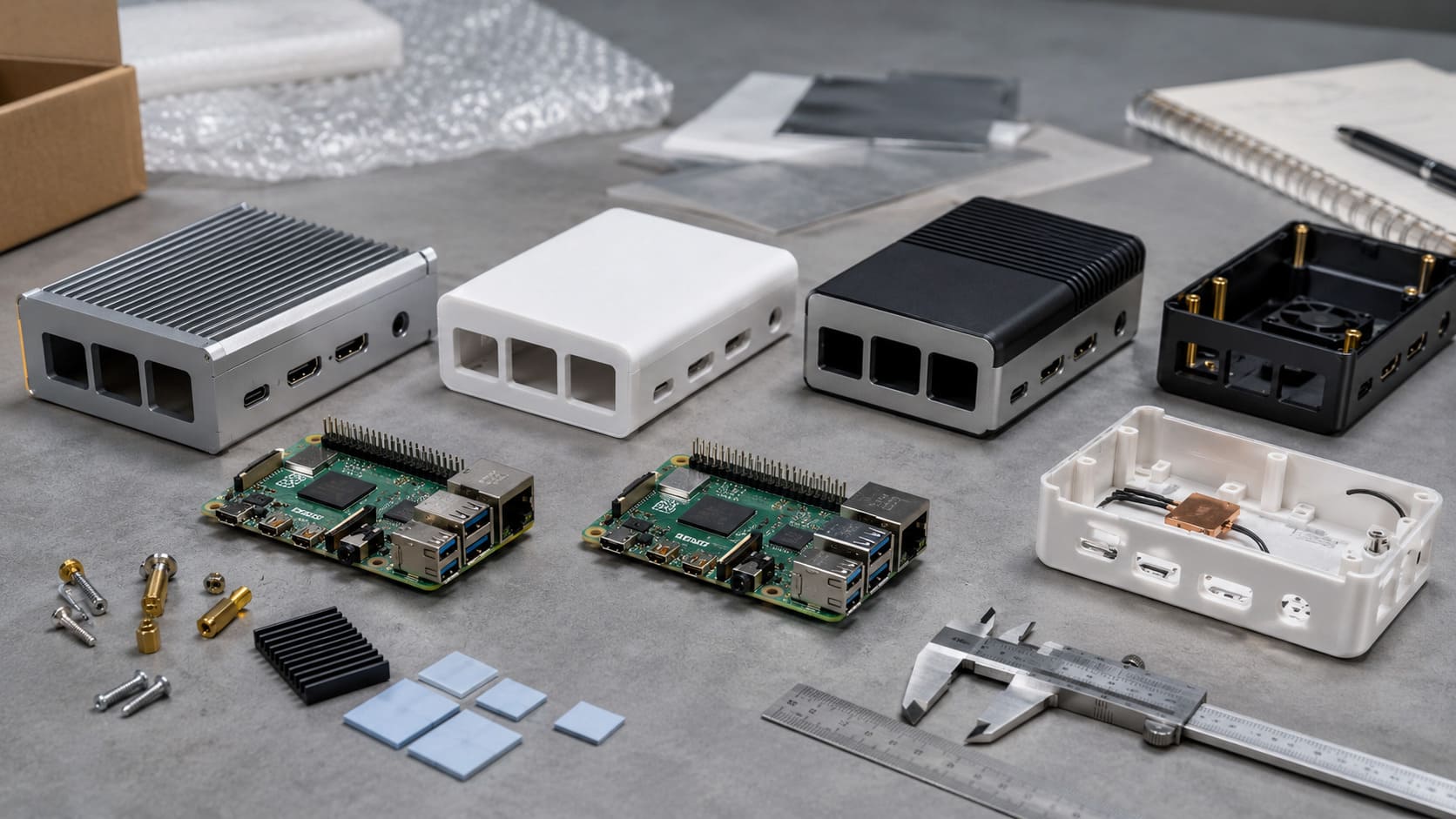
A few nights ago I was hunched over a half-finished print job in our Shenzhen factory, the hum of the laser cutter echoing in the background. My Pi 4 on the bench was stuck compiling code, fans whirring like a tiny jet. I realized—again—how much the right software shapes a project’s fate. Pick smart packages and the Pi feels twice as strong. Skip them and you watch progress crawl.
In this guide I walk you through the tool-kit that keeps my own boards, and the boards my B2B clients depend on, running smooth. We start with the basics, then climb to edge AI. Think of it as my well-worn packing list, shared over coffee.
Why the right packages super-charge a Raspberry Pi
A Raspberry Pi is muscle wrapped in plastic. Packages are the vitamins that let it lift heavier code, stay safe, and stay cool. The wrong mix means late shipments and grumpy buyers; the right mix means Davide in Belgium smiles when his label hits the case.
Quick prerequisites: updating Raspberry Pi OS & enabling 64-bit support
Open a terminal, run sudo apt update && sudo apt full-upgrade, then flip to 64-bit if you run more than 2 GB of RAM. Simple, but so many people skip it and wonder why TensorFlow wheezes.
Ready? Let’s crack open the toolbox.
Essential System Utilities
Terminal & session tools — htop, tmux, screen
I live in tmux. It splits one SSH window into neat panes so I can watch temps, logs, and compile output at once. htop replaces the dull top, showing CPU cores in color. When a build spikes core 3, I spot it before smoke appears.
| Tool | What it shows | Why I care on the factory floor |
|---|---|---|
| htop | Live CPU, RAM, process tree | Quick heat check during stress tests |
| tmux | Multiple panes in one SSH session | Keeps laptop screen tidy while traveling |
| screen | Simple persistent sessions | Survives hotel Wi-Fi drops |
Monitoring & diagnostics — glances, netdata, iotop
Glances gives an at-a-glance health board. Netdata draws fancy graphs in a browser—helpful when I need to show a client proof that the board, not the case, caused the thermal throttle. Iotop tracks runaway SD writes, saving cards from early death.
Backup & snapshot tools — rsync, borgbackup, rclone
I push nightly deltas to an off-site NAS with rsync. For versioned backups, borgbackup compresses and deduplicates; storage costs drop, and so does my blood pressure. Rclone moves images straight to cloud buckets when a buyer wants proof builds.
Smarter package management — apt-file, unattended-upgrades
Can’t remember which deb ships libcamera.so? apt-file search tells you. And unattended-upgrades patches security holes while I sleep—important when units sit in remote kiosks.
System solid? Good. Let’s wire in creativity.
Development & Programming Toolchain
Core build stack — build-essential, git, cmake, make
No compiler, no product. sudo apt install build-essential pulls gcc, make, and friends. Git tracks my frantic midnight tweaks. CMake keeps cross-platform builds sane when a customer wants the same app on Pi 5 and x86.
Python ecosystem — python3-pip, virtualenv, numpy, pandas
Most prototypes start in Python. Virtualenv walls off dependencies, so Davide’s analytics script never collides with Lasle’s camera driver. Numpy crunches sensor arrays; pandas tidies order CSVs before bulk label print.
Web & JavaScript stack — nodejs, npm, yarn, pnpm
A Pi often ends up serving a dashboard. Node 18 is lean enough to run smooth. I favor pnpm for fast installs; cache reuse means less waiting on slow hotel Wi-Fi.
Containerization & orchestration — Docker, Podman, k3s/k3d
Need to demo three firmwares on one board? Throw each in a container. Docker is still king, but Podman runs rootless, which makes security audits easier. For clusters, k3s squeezes Kubernetes into two gigs of RAM.
Coding muscles flexed, we now open doors to the world.
Networking & Remote Access
Secure shell & desktop — openssh-server, xrdp, cockpit
SSH is bread and butter. Xrdp offers a lightweight remote desktop when clients insist on “something Windows-like.” Cockpit gives a clean web UI—helpful for non-Linux engineers who still need logs at 3 a.m.
VPN & mesh networking — wireguard, tailscale, zerotier-one
WireGuard links my factory LAN to a demo rack in Brussels in 30 seconds. Tailscale adds magic by punching through NAT without port forwarding. When a client’s corporate firewall blocks both, ZeroTier often slips by.
File sharing & sync — samba, nfs-kernel-server, syncthing
I drop Gerber files into a Syncthing folder; they appear on the CAM PC before I finish my tea. Samba keeps Windows users happy; NFS streams project media to test players.
Networking wrapped, let’s relax—and play a bit.
Media & Entertainment
Media-center solutions — Kodi, Plex Media Server, Jellyfin
I keep a Pi 4 under the TV in the dorm room near the factory. Kodi boots into a slick menu; Plex shares clips of new case designs with overseas partners; Jellyfin is the open-source fallback when licenses pinch.
Retro-gaming suites — RetroPie, Batocera, Recalbox
Burned out after QC? I load RetroPie and relive 1990s Mario. Clients love seeing a prototype case wrapped around a Pi running Sonic—function plus fun sells.
Audio streaming — Volumio, Mopidy, Airsonic
Volumio pumps chill-step across the workshop. Mopidy grabs Spotify playlists without a screen. For self-hosted audio, Airsonic streams FLAC over VPN to my phone on the highway.
Games done? Time to automate the lights that tell us when a batch is finished.
Home Automation & IoT

Home Assistant Core (supervised install)
I wire test-bench power strips into Home Assistant. One dashboard cuts every rig at shift end. It also emails me if a temperature probe creeps above 70 °C.
Low-code flows with Node-RED
Dragging nodes is faster than writing bash loops. Node-RED logs laser-cutter runtimes, so I know when to change lenses.
MQTT broker: Mosquitto
Every Pi on the line publishes sensor stats. One broker, tiny footprint, instant insight.
Zigbee & Z-Wave bridges — Zigbee2MQTT, ZwaveJS
Cheap Zigbee buttons start timed burn-in tests. Zwave plugs monitor older 110 V tools we ship to Texas.
Automation hums along—let’s open the Pi to the cloud and beyond.
Server & Cloud Services

Network-wide ad-blocking — Pi-hole, AdGuard Home
Factory Wi-Fi feels snappier when trackers vanish. Clients RDP in faster too.
Personal cloud storage — Nextcloud, OwnCloud
I spin up Nextcloud for each project group. Quotes, CAD, and photos live there; no more lost email threads.
Lightweight NAS — OpenMediaVault
Stick two USB SSDs on a Pi 5, enable OpenMediaVault, and you have a quiet parts-catalog server.
Print & scan services — CUPS, SANE
CUPS turns an ancient USB laser printer into a network device; SANE lets the QC desk scan barcodes straight into Nextcloud.
Files sorted. Time for silicon with real smarts.
AI, Vision & Edge Computing

TensorFlow Lite & ONNX Runtime
A Pi 5 with TFLite spots scratches on acrylic edges faster than my trainee’s eyes. ONNX runs the same model on an x86 server, streamlining validation.
OpenCV & libcamera for computer vision
OpenCV measures alignment of logo prints. libcamera feeds raw frames without the old GPU stack headaches.
Local LLMs — llama-cpp, LiteLLM
Need offline chat support on demo kiosks? Llama-cpp squeezes a tiny model into 4 GB RAM. LiteLLM gives one-line API swaps between engines.
Coral Edge-TPU runtime & drivers
Pop a Coral USB in and inference jumps 10×. Perfect for counting boards on a conveyor without hooking to the cloud.
Great power demands great locks—let’s guard the gate.
Security & Hardening

Firewall & intrusion prevention — ufw, fail2ban
ufw enable closes odd ports. Fail2ban bans ssh-password guessers; the log reads like rejected spam.
Rootkit & malware detection — rkhunter, chkrootkit
Monthly scans give peace before shipping units to hospitals, where audits are strict.
Log analytics & alerts — logwatch, goaccess
Logwatch emails a morning digest. Goaccess parses Nginx logs in a browser so I see which partner downloaded the latest STL.
Secure and steady, let’s squeeze every last megahertz.
Hardware & Performance Tuning
Advanced raspi-config options
Enable I2C, SPI, and camera in one menu. Reboot once, not five times.
Overclocking & power tools — cpufrequtils, vcgencmd
A subtle bump from 1.8 GHz to 2.0 GHz cuts compile time 12 %. vcgencmd measure_temp keeps me honest.
GPIO libraries — pigpio, gpiozero, wiringpi
pigpio handles PWM fans that cool my aluminum cases. gpiozero makes quick button prototypes trivial.
System dashboards — RPi-Monitor, Grafana + Prometheus
RPi-Monitor is a one-command install. For fancy graphs, I scrape Prometheus and chart in Grafana—clients love the polished look.
Tools in place, let’s land the plane.
Conclusion
Recap of package categories & deployment tips
From core utilities to edge AI, each group of packages solves a factory pain point. Install them in layers: system, then dev, then specialty stacks. Your uptime—and reputation—will thank you.
Staying updated while maintaining stability
Set unattended-upgrades on security only, pin mission-critical versions in apt-mark hold, and test updates on a spare board before fleet rollout.
Encourage experimentation—backup first, break less
Take snapshots with borg or rclone before wild tweaks. Then push boundaries. A Raspberry Pi rewards the curious, and so do customers who receive builds that simply work.
Now it’s your turn—fire up a fresh SD card, pour another cup of oolong, and see how far your Pi can run.