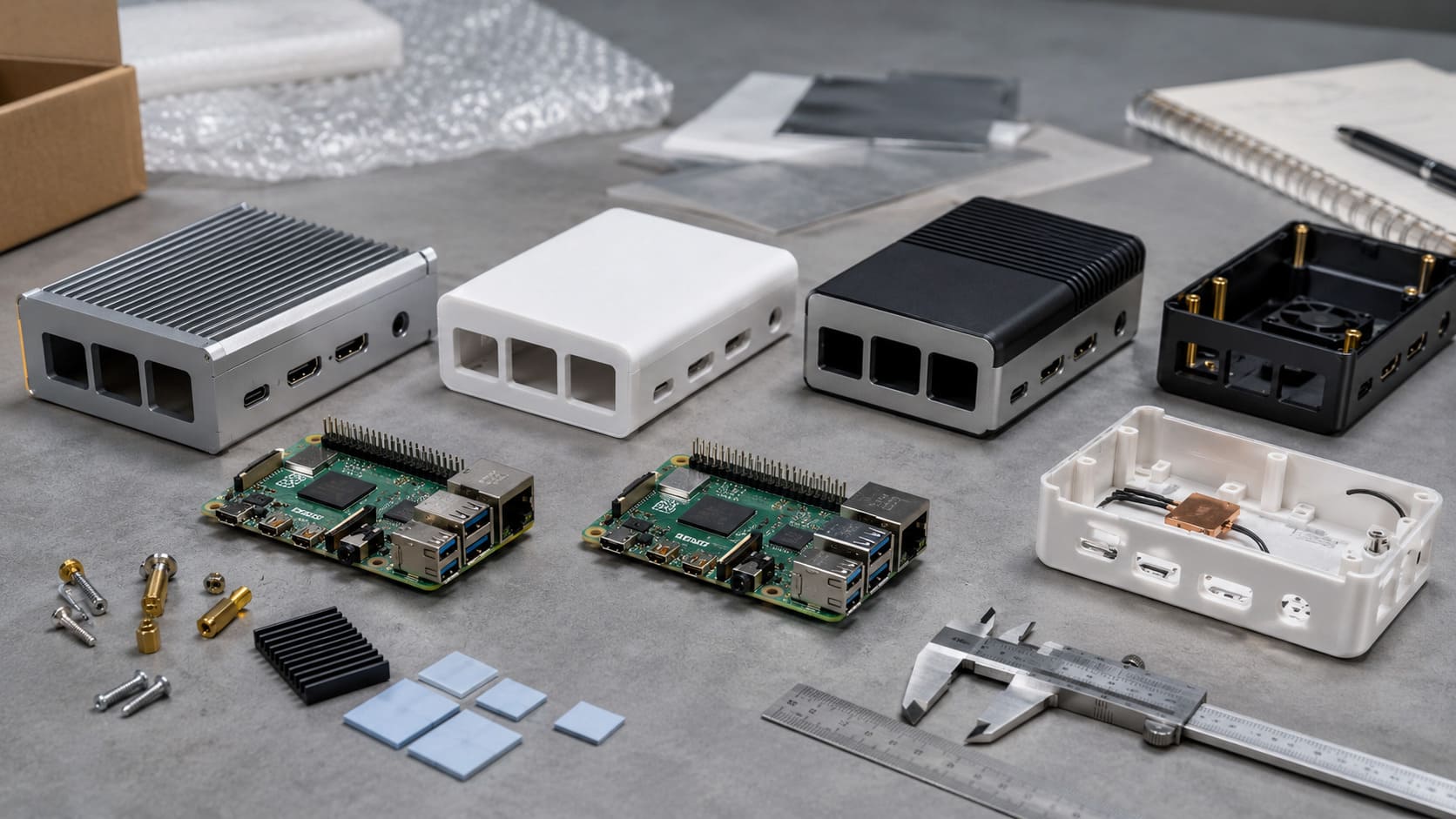
The ultimate guide for Raspberry Pi case gives clear info on picking, using, and keeping the best cases for Raspberry Pi in the United States. A right case helps keep the board safe, cool, and easy to use in real projects at home or work.
Like all things Pi, the options are numerous, ranging from basic plastic enclosures to elaborate metal cases with built-in cooling fans. This guide is intended to assist you in matching case features with daily needs and American setups.
What Is a Pi Case?

A Pi case is an enclosure or shell that is designed to house a Raspberry Pi computer. Whether you’re using your Pi for DIY projects or classroom activities, a Pi case protects it while allowing for ventilation. It protects the board from dirt, bumps, and static, keeping it safe and functioning at its best.
A quality case significantly reduces the chance of short circuits and protects the board from everyday damage. Some of these cases even feature excellent cooling solutions, employing metal exteriors or integrated heat sinks to dissipate heat quickly. This helps keep the device operating cool under pressure, especially when the workload becomes intense.
Beyond safety, a Pi case can give a project panache and polish. For example, makers are left to choose between plain black boxes. Or they can choose wood shells with carved lines, bright colors, or jewel shapes!
These options give you the freedom to personalize your case to suit your taste. Whether it’s on a desk, in a building shop window, or on display at a school science fair, there’s an application for every environment! If you’re someone who enjoys showing off your tech, a transparent Pi case will do the trick. It allows you to appreciate the board’s beautiful green and the flashy LEDs!
Cases also serve to protect all the wires and accessories you plug into it. The hallmark of a good case is how well it fits and aligns with the Pi’s ports. This open design allows quick and easy access to USB, HDMI, microSD, and GPIO pins.
This means you can easily add a camera, display, or sensor without needing to open the case. Some cases even route cables and store spare boards or fans, keeping everything organized and neat.
How to Pick Your Pi Case

Picking the ideal Raspberry Pi case really just boils down to three main factors that dictate both functionality and user experience. These factors are model compatibility, project intent, cooling requirements, material selection, and port accessibility.
Every project has its own requirements. The ultimate goal should be to match the case features to your intended use of your Pi!
- Match your case to your Raspberry Pi model
- Define your project’s main goal before choosing
- Consider heat, airflow, and cooling solutions
- Pick a material for durability and heat handling
- Make sure all ports stay easy to reach
1. Know Your Pi Model
Not every Raspberry Pi case is created equal.
Board Layout The Pi 4, Pi 3, and Pi Zero all have different board layouts and port positions. While some cases accommodate just a single model, other cases change to suit multiple models.
A case made for a Pi Zero isn’t going to accommodate a Pi 4. This is due to size and port changes, but an evolutionary step in technology. Caveat emptor — consult the official specs before making any purchases!
Even minor changes, such as micro HDMI versus full HDMI ports, can have a huge impact on fit and function.
2. Define Your Project's Goal
Determine what your project is trying to accomplish. A portable gaming rig requires a lightweight, compact case to achieve the intended portability factor.
A home server needs a strong, well-ventilated casing for extended use. If you intend to use hats or shields, choose a case with interchangeable or open-topped lids.
For classroom or educational builds, immediate access to GPIO pins can be helpful.
3. Think About Heat & Airflow
Additionally, running resource-intensive applications or overclocking the Pi will increase temperatures. Lack of proper airflow drastically reduces performance and shortens the lifespan.
If you’re using your Pi case for more intensive applications, look for cases with ventilation, fans, or built-in heat sinks. While passive cooling would work fine for light loads, active cooling is a better choice for gaming or server applications.
4. Choose Case Material Wisely
Plastic cases are lighter in weight, less expensive, and available in a variety of colors. Metal cases, usually made of aluminum, increase heat dissipation and are more durable.
Wood may be the most aesthetically pleasing option and is definitely the least common, but it won’t aid in heat dispersion. Each one has its own unique combination of aesthetics, durability, and heat dissipation.
5. Ensure Easy Port Access
Ideally, cases should align with all other ports—USB, HDMI, Ethernet, and GPIO. Nothing is worse than misaligned cutouts creating a headache, particularly if you’ve got a few add-ons.
Many cases cover GPIO or camera slots, so make sure to look closely for your intended use.
Common Raspberry Pi Case Styles
When choosing a case for your Raspberry Pi, the choices can seem overwhelming. Since every style accommodates a distinct type of project, user skill level, and overall setup, we’re going to break down each one. Options vary from basic enclosures to industrial strength ruggedized cases.
While there’s an appeal to some users in showing off the board, others are more concerned with cooling options or customized fits. Choosing an appropriate style can save time and even extend the life of a project. Here are some well-known case styles you’ll find on the market:
- Basic shells
- Fan-cooled cases
- Tough, rugged cases
- Open designs
- DIY custom builds
- Passive-cooled cases
- NUC-style compact cases
- Cases with easy GPIO or microSD access
- Mounts or stands
Basic Shells: Simple & Sweet
Basic shells don’t get much simpler than this. They protect the board from dust and inadvertent knocks in a very economical package. They’re made of plastic and snap together in just a few seconds.
These are the ideal case styles for novices or anyone working on a relatively straightforward project. They add very little bulk and weight but offer mediocre protection. It’s a trade-off: more access and less bulk, but less defense against drops.
Fan-Cooled Cases: Beat Heat
Fan-cooled cases keep cases cool and quiet. They’re essential for anyone planning to run large workloads, overclock the Pi, or use the Pi somewhere warm, like a car. Airflow prevents the board from suffering from thermal throttling.
Other cases allow users to manually adjust fan speed for quieter operation or increased cooling. Integrated heatsinks are another blessing, sucking the heat right off the chips.
Tough Cases: Built to Last
Tough cases are made with durable materials such as metal or rubber. They’re ideally suited for use in outdoor projects, factories or industrial spaces, or classrooms. Most feature shock resistance or waterproof seals.
These embedded features provide protection against drops, spills, and outdoor elements. They aren’t the tiniest, but they’re built to withstand the test of time.
Open Designs: Show It Off
Open designs allow users to view all of the chips and wiring. These types of cases are ideal for the user who needs frequent access or enjoys a more hands-on approach. They’re visually impressive and heavily customizable, but dust can accumulate quickly.
Many of them compensate by adding shields or covers, but you will have to wash these cases much more frequently.
DIY Cases: Your Unique Build
DIY cases allow makers to express their creativity. Whether they utilize 3D-printing, laser cutting or just customized LEGO bricks, the ingenuity is hard to resist. Forums and websites such as Thingiverse are full of inspiration.
If you build your own cases, you are able to get the perfect fit for any project. After all, it’s incredibly rewarding to look down at your own creation sitting atop your desk.
Smart Case Features to Consider

Bottom Line: When searching for the perfect Raspberry Pi case, you’ll want to consider both function and form. Smart case features like these can go a long way in making sure the case works best for your project and everyday use. Recent patterns show an increase in cases with integrated technology.
These features range from cooling fans, touch screens, and integrated HAT boards, attracting makers who want so much more than a plastic enclosure. Below, a quick table runs through some of the more ubiquitous smart features that enhance usability and performance.
| Feature | Benefit | Example |
|---|---|---|
| Passive/Active Cooling | Keeps the device cool under load | Built-in heat sinks, fans |
| Easy Port Access | Quick access for add-ons or cables | Removable panels |
| Modular Build | Flex for upgrades (e.g., SSD, RTC) | Snap-on layers, trays |
| Built-in Power Button | Quick start/stop | Top or side button |
| Tidy Cable Routing | Cleaner setup, better airflow | Internal cable guides |
| Aesthetic Choices | Personalized, professional look | Branded or colored shells |
Room for Add-ons
A great case will always allow room for improvement. With modular cases, adding or swapping out an SSD, battery pack, or fan is a snap. This is especially important for projects that are likely to expand in scope.
Be sure to look at the interior dimensions of any case you’re considering before making a purchase. Other cases accommodate more than just a board, with slots for additional components. This leaves room for add-ons if you plan to build them in the future.
Tidy Cable Solutions
A tangled cable mess can restrict airflow or even short something out. Whether they’re cable guides or cable cut-outs, cases that feature a solution for cable management look cleaner.
Smart Case Feature #4: Tidy Cable Solutions. Cables can be annoying, and some cases allow you to tuck them inside for a cleaner aesthetic. This is useful if you transport the Pi frequently or just want to showcase your build.
Looks That Impress
First impressions are important in every arena, and the same goes for your smart case. Having a cool looking case goes a long way to making a project feel like it’s complete, not haphazardly thrown together at the last minute.
Consider color and design, including logo placement, when selecting a case. A sleek case can make a Pi at home or in the office blend in or stand out, as you want.
Assembling Your Case: Quick Tips

The right approach to Raspberry Pi case assembly protects your valuable single board computer and ensures continued high performance. Understanding the mechanics of each action cuts down on frustration and ensures that your system holds up over time.
Here’s a simple walk-through:
- Begin by laying the bottom portion of your case on a clean, flat surface.
- Place the Raspberry Pi board in the bottom, ensuring that all ports are aligned with the case cutouts.
- Install heat sinks or cooling pads if your case supports them.
- Include standoffs or spacers as required to avoid movement of the board.
- With a small Phillips screwdriver, secure the board, being careful not to overtighten.
For custom cases, a 2 mm ball end mill should be used to achieve sharp, clean edges. To enlarge grooves for telephone cables, a special drilling machine makes it easy—just push the post back and forth to create a clean groove.
Carefully close the top half, making sure that each clip or screw engages properly. First, attach the HDMI and power cables. Then, reseat your microSD card – Class 10, 8GB or above recommended for speed!
Ensure you have the correct power supply—5V, 2.5A for the Pi 3.
A few tips to keep your build solid: Verify all ports and vents to ensure free flow of air and combustion. Test and retest each junction before turning on the power.
Don’t try to make a fit; forcing can break cases or bend pins. Tighten all fasteners snugly, but do not strip threads or overtighten. Sufficient ventilation and proper component alignment prevent overheating or electrical issues.
Keep Your Pi Case Fresh

Taking care of your Raspberry Pi case will help keep your Raspberry Pi board running at its best. It helps your device last longer! A smart, tidy, dust-free case is always more appealing aesthetically as well as in how well it cools. Cases designed with excellent cooling features are particularly beneficial.
Dust builds up fast, particularly in cities with homes or offices near major roadways. When it clogs vents, the Pi can overheat. Cases that have ample, unobstructed airflow and/or mesh panels have a much better chance of staying cool, especially when using accessories like an active cooler.
For people who have their Pi running 24/7—such as for media servers, home automation, etc.—it’s a good idea to monitor for dust on a monthly basis. For smooth, shiny cases, wipe them down with a microfiber cloth. Fingerprints and scratches show up in a hurry, especially on acrylic or clear plastic!
Many of those cases end up warm to the touch. This can indicate bad airflow or excessive dust build up inside. Heat sinks and fans are effective, but only if the case allows air to circulate properly. An aluminum case may provide better heat dissipation compared to plastic options.
Convenient access is important, though. A case with an exposed slot for the SD card allows for easy updates and SD card swaps. Sometimes getting to the USB or GPIO pins is difficult, particularly in compact designs.
That can be a buzzkill if you like to tinker or want to connect other sensors. Consider how you’re routing your cables. Tight spaces can prevent you from easily plugging in new devices or swapping out wires! A case with ample space for display cables can enhance usability.
While metal or well-shielded cases will generally block noise coming from nearby electronics, we find that some of the cheaper acrylic models allow a bit more interference. If you often upgrade your Pi or switch up projects, look for a case that’s simple to open up.
Find one that closes back up without a fuss! Case swap as new releases arrive to keep your Pi cool and cutting edge.
Conclusion

An ideal Raspberry Pi case would provide the ultimate convenience while ensuring your board remains protected. You end up with less dust, less heat, and far fewer headaches. Look for a case that suits your Pi and your configuration. Look for features such as good airflow, easy access to your components, and a modern, clean-looking transparent top. Looking to get a little crazier? Consider a case that comes with fans pre-installed, or has room for fans or fan add-ons. Setting up a case is super quick as well — only a few minutes! You’ll just be sparing yourself a lot of headaches later. Watch your operating temperature, clean your case periodically, and inspect your case, and your Pi will be around for a long time. Have a favorite case or a Raspberry Pi hack that does the trick for you? Leave your comments in the comment section below and assist other readers in making better choices.
Frequently Asked Questions
What is the main purpose of a Raspberry Pi case?
What is the primary function of a Raspberry Pi case? Apart from protecting the board computer, it provides excellent cooling and makes your setup organized.
Are all Raspberry Pi cases compatible with every model?
False, different Raspberry Pi cases are specific to each model. When in doubt, always verify that a suitable case is made for your specific Raspberry Pi model for the best fit possible.
Does a case help prevent my Raspberry Pi from overheating?
Does a new case offer excellent cooling benefits to prevent my Raspberry Pi from overheating?
Can I access all ports with a case on?
Best of all, most modern cases let you maintain access to all ports. That’s right, no need to take the case off to access HDMI, USB, or any other ports!
What are the best materials for Raspberry Pi cases?
Plastic and aluminum Raspberry Pi cases, including the new cases available, reign supreme. You can’t beat plastic for lightweight, low cost, while aluminum cases provide excellent cooling and sturdiness.
How do I clean my Raspberry Pi case?
Unplug and power down your Pi before cleaning. We recommend using a soft, dry cloth to wipe down the exterior of the case. For tough stains, try a lightly damp rag—harsh cleaners should never be used.
Is it hard to assemble a Raspberry Pi case?
As for assembly, most cases, including the favorite Raspberry Pi cases, are a breeze with intuitive snap-together or screw-on designs. Refer to the provided instructions for optimal performance.