I still remember the first time I turned the lights on in my apartment with nothing more than a Raspberry Pi, a relay board, and an excited grin. It was 2 a.m., Shenzhen was buzzing outside my window, and I felt like Tony Stark—minus the suit and the billions. That tiny board made me realize how close smart‑home magic is to anyone willing to tinker. In this post I’ll share what I’ve learned—both the sparks and the short circuits—so you can build a system that actually works for you.
Why Raspberry Pi for Smart Home Automation
The Pi is cheap, small, and surprisingly powerful. With GPIO pins for hardware hacks and a huge community for software, it bridges the gap between hobby and pro. Plus, unlike closed hubs, you keep control of your data.
The Growing Appeal of DIY Smart Home Projects
Rising subscription fees, privacy worries, and plain curiosity push more people to roll up their sleeves. A custom setup can cost less, respect your privacy, and do exactly what you want—no “premium tier” required.
A quick confession before we dive deeper: every failure I share here comes from personal bruises. Consider them friendly warnings, not distant theory.
(Ready for the bigger picture? Let’s zoom out.)
Understanding the Raspberry Pi Smart Home Trend
Affordable Hardware & Flexible Applications
A Pi 4 costs less than a fancy dinner, yet it can run lighting, HVAC, cameras, and your cat feeder. Add sensors or Zigbee sticks as your needs grow. If you break it, you’re out a pizza—painful, but not fatal.
Community‑Driven Development & Open‑Source Advantages
Because thousands of hobbyists and pros share code on GitHub, bugs get squashed fast and new integrations pop up daily. You’re not locked into a single vendor’s roadmap. Of course, freedom means you read docs at 1 a.m. instead of calling support, but I’d rather lose sleep than lose control.
(Curious how to judge all these projects? Grab a coffee—criteria time.)
Key Criteria for Selecting Smart Home Software

| Criterion | Why It Matters | Quick Check |
|---|---|---|
| Compatibility | Works with your bulbs, locks, APIs | Search the device list first |
| Install Ease | Saves hours of head‑scratching | Does it offer an image or script? |
| Automation Depth | Handles simple timers and complex flows | Look for YAML, Blockly, or Node‑RED support |
| Security | Protects your home network | HTTPS, 2‑FA, active patches |
| Community | Answers at 2 a.m. | Size of forum, GitHub commits |
Compatibility & System Requirements
A Pi Zero might be fine for simple tasks, but throw 4K cameras at it and you’ll beg for a Pi 4. Always match horsepower to workload.
Ease of Installation & Setup
Some projects offer ready‑made images; others expect you to compile from source. If you dread terminal commands, pick the former.
Automation & Customization Capabilities
Think through future needs. Will you want geofencing? Machine‑learning triggers? If yes, choose software that scales.
Security & Privacy Considerations
Open ports are open doors. Favor HTTPS, frequent updates, and local processing over cloud‑only solutions.
Community Support & Documentation
A vibrant forum can save you from rage‑quitting. Check how fast issues get closed on GitHub.
(Criteria sorted—now let’s meet the contenders.)
Best Raspberry Pi Smart Home Software Options
Below is a snapshot. I’ve broken out pros, cons, and when each shines.
| Platform | Strengths | Trade‑offs |
|---|---|---|
| Home Assistant | Polished UI, 2000+ integrations, active devs | YAML can intimidate, resource‑hungry |
| OpenHAB | Modular, strong rules engine, Java‑based | Steeper learning curve, slower UI |
| Domoticz | Lightweight, simple dashboards | Fewer integrations, dated look |
| Node‑RED | Visual flow builder, flexible, MQTT friendly | Not a full “hub” out of the box |
| Pi‑hole | Blocks ads network‑wide | Not automation focused |
| Mozilla WebThings | Privacy‑first, open standards | Smaller community |
| MisterHouse | Perl veterans’ playground | Dated docs, niche user base |
Home Assistant
Key Features
- Lovelace UI, Add‑on store, Energy dashboard.
Pros and Cons
Pro: Vast device support. Con: Updates can break configs.
Ideal Use Cases
Whole‑house control where you want a slick phone interface.
OpenHAB
Key Features
- Powerful rule DSL, HABPanel dashboards.
Pros and Cons
Pro: Runs on anything with Java. Con: Initial setup verbose.
Ideal Use Cases
Environments needing complex logic, e.g., factories or large homes.
Domoticz
Key Features
- Minimal resource use, JSON API.
Pros and Cons
Pro: Great for Pi Zero. Con: Limited modern integrations.
Ideal Use Cases
Simple cabins, off‑grid sensors.
Node‑RED
Key Features
- Drag‑and‑drop flows, huge npm library.
Pros and Cons
Pro: Infinite flexibility. Con: Requires you to design dashboards.
Ideal Use Cases
Makers who think in wires and boxes.
Other Noteworthy Tools
- Pi‑hole – network ad blocker.
- Mozilla WebThings – privacy‑centric IoT gateway.
- MisterHouse – old but gold for X10 setups.
(Picking software is half the battle; let’s wire up the hardware.)
Setting Up a Raspberry Pi for Smart Home Solutions

Hardware Requirements
Recommended Raspberry Pi Model
Pi 4 B with 4 GB RAM is my sweet spot; 8 GB if you plan on AI video.
Essential Accessories (SD Card, Power Supply, etc.)
- 32 GB Class 10 SD
- 5 V 3 A power brick
- Ethernet cable for first boot
Installation & Configuration Steps
Preparing the SD Card
Flash the OS with Raspberry Pi Imager and enable SSH.
Connecting to Network & Peripherals
Hard‑wire first, then move to Wi‑Fi once stable.
Basic Software Setup & Initial Tests
Update packages, set timezone, test GPIO with an LED. If it blinks, you’re golden.
(Now that the core is alive, let’s give it some armor and turbo.)
Enhancing Performance with Additional Accessories

Protective & Customizable Cases
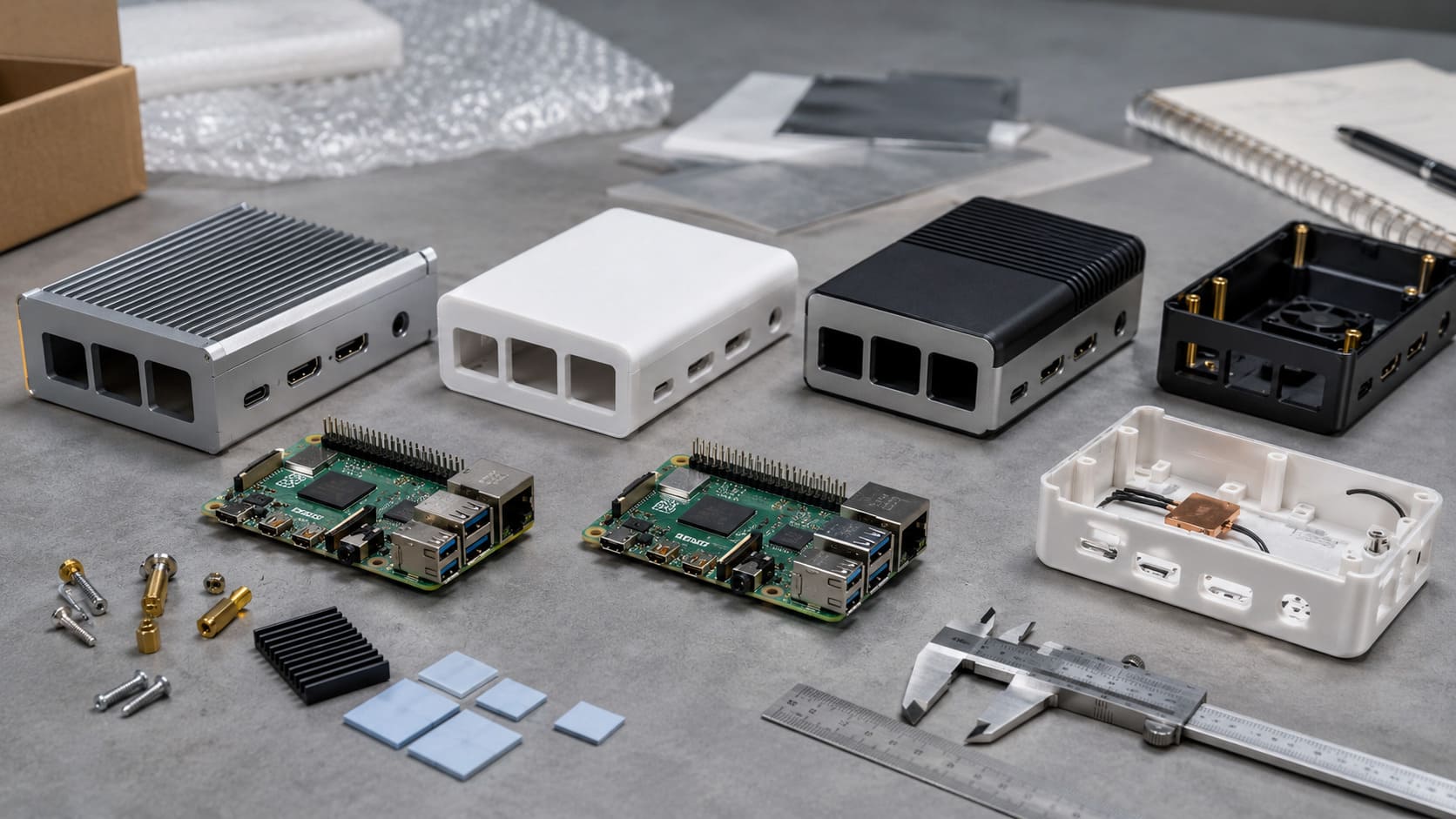
Acrylic cases keep dust out and look sharp on a shelf. I engrave my logo on them in the factory—cheap branding win.
Power Supply Considerations (UPS & Stable Power)
A micro UPS prevents SD corruption during blackouts.
Heat Management (Heatsinks & Fans)
Passive copper sinks handle light loads; add a 30 mm fan for summer in Guangzhou.
Networking Upgrades (Ethernet vs. Wi‑Fi)
Ethernet is king for latency‑sensitive automations like motion lights.
(Accessories ready—let’s see what the Pi can actually do in real homes.)
Real-World Applications & Use Cases
Smart Lighting & Climate Control
Motion sensors trigger hallway LEDs at night. Temperature sensors nudge HVAC only when rooms are occupied, saving energy.
Voice Control & Digital Assistants
Integrate with Alexa or Mycroft. I once shouted “movie time” and the Pi dimmed lights, closed curtains, and started the projector—no popcorn maker yet.
Home Security & Surveillance
Use a Pi‑powered camera, local storage, and off‑site backups. Critical if you mistrust cloud CCTV.
Entertainment & Multimedia Integrations
Combine Kodi with MQTT to pause music when the doorbell rings. Small trick, big brownie points with guests.
(Great features come with great responsibility—let’s keep things running.)
Maintenance & Troubleshooting Tips

Updating & Backing Up Your System
Schedule weekly snapshots to an external drive. If an update misbehaves, roll back pain‑free.
Common Issues & Quick Fixes
| Symptom | Likely Cause | Fix |
|---|---|---|
| Random reboots | Weak PSU | Upgrade supply |
| Slow UI | SD wear | Move database to SSD |
| Zigbee drops | Wi‑Fi interference | Change channels |
Community Resources & Expert Support
Forums, Discord, and Stack Exchange answer most questions. If all else fails, a fresh SD card often cures mysterious woes.
(We’re almost home—time to wrap up.)
Conclusion
A Raspberry Pi can be the beating heart of a smart home that’s private, flexible, and truly yours. Pick software that fits your skill level, give the hardware the love it deserves, and remember: every glitch is just another line in your success story. If you ever need a sturdy case or a sanity check, drop me a line—my inbox is always open.