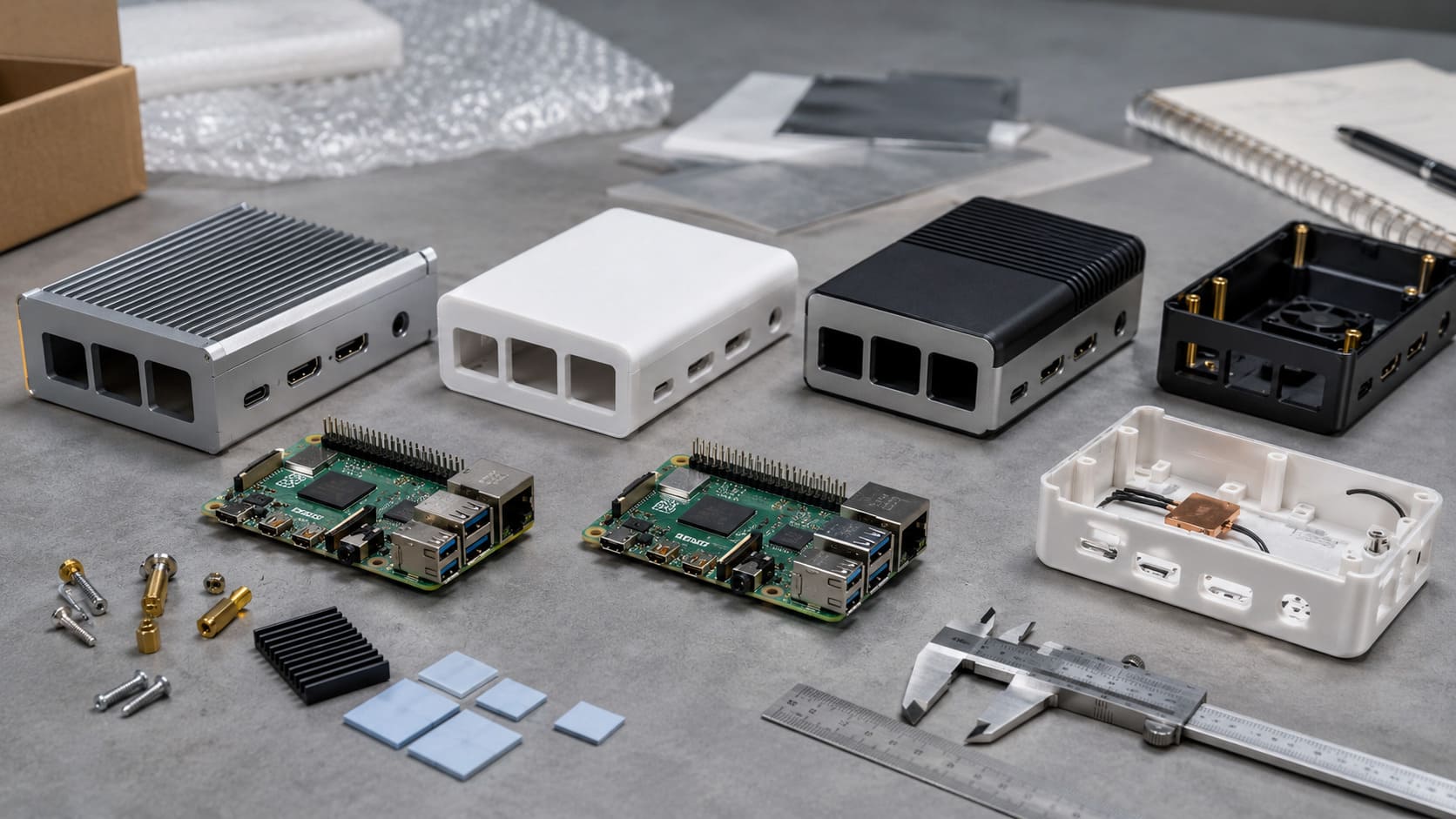
Some mornings at the factory start with questions I didn’t plan for. A buyer messaged me while I was checking a fresh batch of Raspberry Pi 5 cases. He asked if we could ship his order with the OS already installed. Not a big request, but it raised a familiar problem — choosing the right OS for different clients is never as simple as it looks.
Every buyer comes with a different purpose. People like Jackson want something stable and beginner-friendly for their Amazon customers. People like Lasle need a clean and flexible base for their custom projects. And when you sit between both worlds, like I do, you start to see how important the OS becomes in shaping the whole user experience.
So this guide focuses on the 10 best operating systems for Raspberry Pi, but from the angle of people who buy, sell, customize, and build around it. If you're sourcing cases, rebranding kits, or preparing a Pi-based product, the right OS doesn’t just run your device — it supports your business.
1. What to look for when choosing an OS for Raspberry Pi

Choosing an OS isn’t about grabbing the first one you see. It’s about balancing performance, stability, compatibility, and deployment ease — especially if you're bundling it with your custom Raspberry Pi case.
Compatibility with Raspberry Pi models
Different OSes support different models. For example, newer 64-bit distros may not run well on older Pi 2 boards. Always check whether the OS supports your target board — Pi 3, 4, 5, or Zero.
| OS Name | Pi 3 | Pi 4 | Pi 5 | Pi Zero |
|---|---|---|---|---|
| Raspberry Pi OS | ✅ | ✅ | ✅ | ✅ |
| Ubuntu MATE | ✅ | ✅ | ✅ | ❌ |
| LibreELEC | ✅ | ✅ | ✅ | ✅ |
Performance & resource usage
Not all your customers need a heavy GUI. Some just need headless performance. Lightweight OSes like DietPi make sense for those running automation or edge devices. Meanwhile, desktop-style OSes offer a richer experience for beginners or education kits.
Community support & updates
The bigger the community, the better the updates and support. That means fewer customer complaints and faster fixes.
Specialisation (desktop, server, media, gaming)
Each OS has a personality. Some are built for media centers. Others are for servers. Know what your buyer needs — and match accordingly.
Ease of deployment in a custom-case / kit business
If you're preloading SD cards or offering full kits, OSes with stable images, fast boot, and customization support are gold.
I learned that the hard way when a client’s preloaded kits failed because an update broke compatibility with their display drivers. That day taught me: stability first.
When you finally feel you’ve got it figured out, along comes the official Raspberry Pi OS — let's talk about why it’s still the first name on most lists.
2. The official go-to: Raspberry Pi OS

This is the default for a reason. Formerly known as Raspbian, Raspberry Pi OS is developed by the Raspberry Pi Foundation and fine-tuned for every model.
Why it’s the default choice
- Built specifically for the Pi
- Great hardware compatibility
- Massive documentation support
- Frequent updates
Key features & benefits
It comes with a polished LXDE desktop, pre-installed apps like Chromium, and beginner-friendly tools. It’s the perfect “out-of-the-box” OS.
Ideal use-cases for B2B buyers
If your customers include educators, first-time tinkerers, or kit builders, Raspberry Pi OS is the easiest win. It’s also great for re-brand kits that don’t need heavy tweaks.
Potential drawbacks
If you're building something unique — like a performance-tuned server or a media player — the official OS might be a little too general.
Now, let’s say your client wants something that feels a little more like a regular desktop. That’s where general-purpose distros come in.
3. General-purpose desktop distros

Not every Pi needs to act like a Pi. Some users want it to feel like a real desktop computer — and for that, distros like Ubuntu MATE or Manjaro are great picks.
Ubuntu MATE (or Ubuntu Desktop)
Ubuntu MATE is friendly, polished, and recognizable. It has a clean UI and better accessibility for people switching from Windows or macOS. It’s also well-maintained.
Manjaro / Arch-based options
Arch is for power users, and Manjaro brings that flexibility in a more stable way. If your clients are devs or tinkerers, these might be a match.
Key advantages & trade-offs
| OS | Pros | Cons |
|---|---|---|
| Ubuntu MATE | User-friendly, familiar UI | Heavier resource usage |
| Manjaro | Rolling updates, advanced tools | Steeper learning curve |
When clients ask, “Can I run my full dev environment on this Pi?”, this is where I point them.
Of course, not everyone wants a desktop. Some want a clean, server-style base.
4. Server and DIY projects OS

When Lasle came to me with a custom case idea for a sensor gateway, he didn’t need a GUI — just speed, stability, and terminal access. That's a job for a headless OS.
Ubuntu Server
Ubuntu Server offers enterprise support and runs well on Pi. Great for web hosting, IoT, and project deployments.
Debian-based Lite / headless variants
Raspberry Pi OS Lite or minimal Debian builds are incredibly stable and lightweight.
What to consider for industrial / productised use
- Long-term support
- Kernel customization
- Easy network setup
- SSH and remote access
Tip: For factory pre-deployment, you can create base images with default configs, Wi-Fi settings, and scripts pre-burned.
And if your client says, “I want to plug it into my TV,” then we shift gears again.
5. Media-centre / HTPC operating systems

We once helped a distributor bundle Pi kits for hotel room TVs. What made the difference? Preloading LibreELEC. Plug and play. No fuss.
LibreELEC
Super lightweight, purpose-built for Kodi. It boots directly into the media interface. Runs well even on Pi Zero.
OSMC
More customizable than LibreELEC, and also Kodi-based. It offers a prettier UI and extra plugins.
Why media use-cases are relevant for Raspberry Pi kits
Entertainment bundles, digital signage, and hospitality solutions all benefit from a media OS. If your buyer wants HDMI out and remote control — this is the road.
Gaming, however, is another beast entirely.
6. Retro-gaming & emulation OSes

You wouldn’t believe how many Amazon shops we’ve supported with Raspberry Pi-based retro kits. The demand keeps climbing.
RetroPie
The king of emulation. Supports dozens of consoles. Big community. Custom themes and UI.
Lakka
Lightweight and built around RetroArch. Cleaner UI, simpler experience, fewer tweaks.
The growing market for Raspberry Pi gaming kits
Retro gaming kits with pre-installed SD cards and cases modeled after classic consoles? Hot sellers. Especially in Q4.
Not every setup needs nostalgia, though. Some need speed and silence.
7. Lightweight / minimal / custom build OSes

There was this one custom enclosure we designed that had zero airflow. No HDMI, no USB. Just GPIO headers and a PoE hat. The OS? DietPi.
DietPi
Minimalist. Text-only installer. You pick what gets installed. Perfect for low-power embedded setups.
Tiny Core / piCore
Even smaller than DietPi. Great for advanced users, but limited device support.
When minimalism is the requirement (embedded, custom case)
Sometimes less is more. Especially when space, power, or thermal limits are tight.
But what if your client wants something a bit... off the beaten path?
8. Security / specialist OSes
Some clients build testing devices. Others run security demos at tradeshows. These are niche, but powerful.
Kali Linux
A full suite of penetration testing tools. Not for everyone — but great for ethical hacking or cybersecurity training.
RISC OS (or other niche ARM OSes)
RISC OS isn’t Linux. It’s fast, quirky, and educational. There are others like Void Linux or custom Yocto builds too.
When you might need these in B2B sourcing or industrial settings
If your buyer is in IT, education, or wants an edge case demo — these oddballs might be exactly what they need.
That said, not all Pi buyers are experts. Some are just getting started.
9. OSes geared toward education / kids / beginners

Back when I built our first batch of Pi education kits, I asked the local school: “What do your students struggle with?” Their answer? Setup. Not the code.
Twister OS (or other beginner-friendly)
Twister OS gives users the feel of Windows/macOS with the power of Linux underneath. Preloaded apps, clean UI, fun themes.
How this segment fits into your accessory / kit business
If you’re selling to schools, parents, or education NGOs, these OSes make learning smoother — and cut down on support tickets.
But how do you choose the right OS when there’s so many paths?
10. Choosing the right OS for your client’s custom-case project

This is where everything comes together — hardware, enclosure, market, and software.
Matching OS to the hardware + custom case + accessory bundle
If your case blocks HDMI, don’t choose an OS that boots to desktop. If you ship with camera modules, choose one with drivers pre-loaded.
Considering target market: Amazon re-brand, project base, educational kit
| Client Type | Ideal OS | Reason |
|---|---|---|
| Re-brand (Jackson) | Raspberry Pi OS / Twister | Easy setup, low return risk |
| Project (Lasle) | DietPi / Ubuntu Server | Headless, customizable |
| Education | Twister / Raspberry Pi OS | Kid-friendly UI |
Example scenarios: Jackson’s Amazon rebrand vs Lasle’s OEM redesign project
Jackson wants fast delivery, low support issues, and a clean UI. Lasle wants GPIO access, minimal bloat, and long-term stability. Their OS needs? Totally different.
Checklist for factory-to-buyer handoff: OS pre-install? image, custom logo, user documentation
- Confirm board model
- Choose stable OS version
- Pre-burn image with configs
- Add logo splash if needed
- Include printed or digital guide
It’s not just about delivering a product — it’s delivering peace of mind.
Conclusion
Choosing the right OS isn’t just a technical decision — it’s a business decision. It affects your customer’s first impression, your return rate, your support inbox.
If you’re selling, sourcing, or building kits — this decision matters more than it seems.
At MaidaTech, we help clients like Jackson and Lasle build kits that actually work — from custom enclosures to preloaded OS images. If you're thinking about bundling the right software with your next batch, let's talk. I’ve been there. I’ll walk with you.
You bring the idea — we’ll bring it to life.