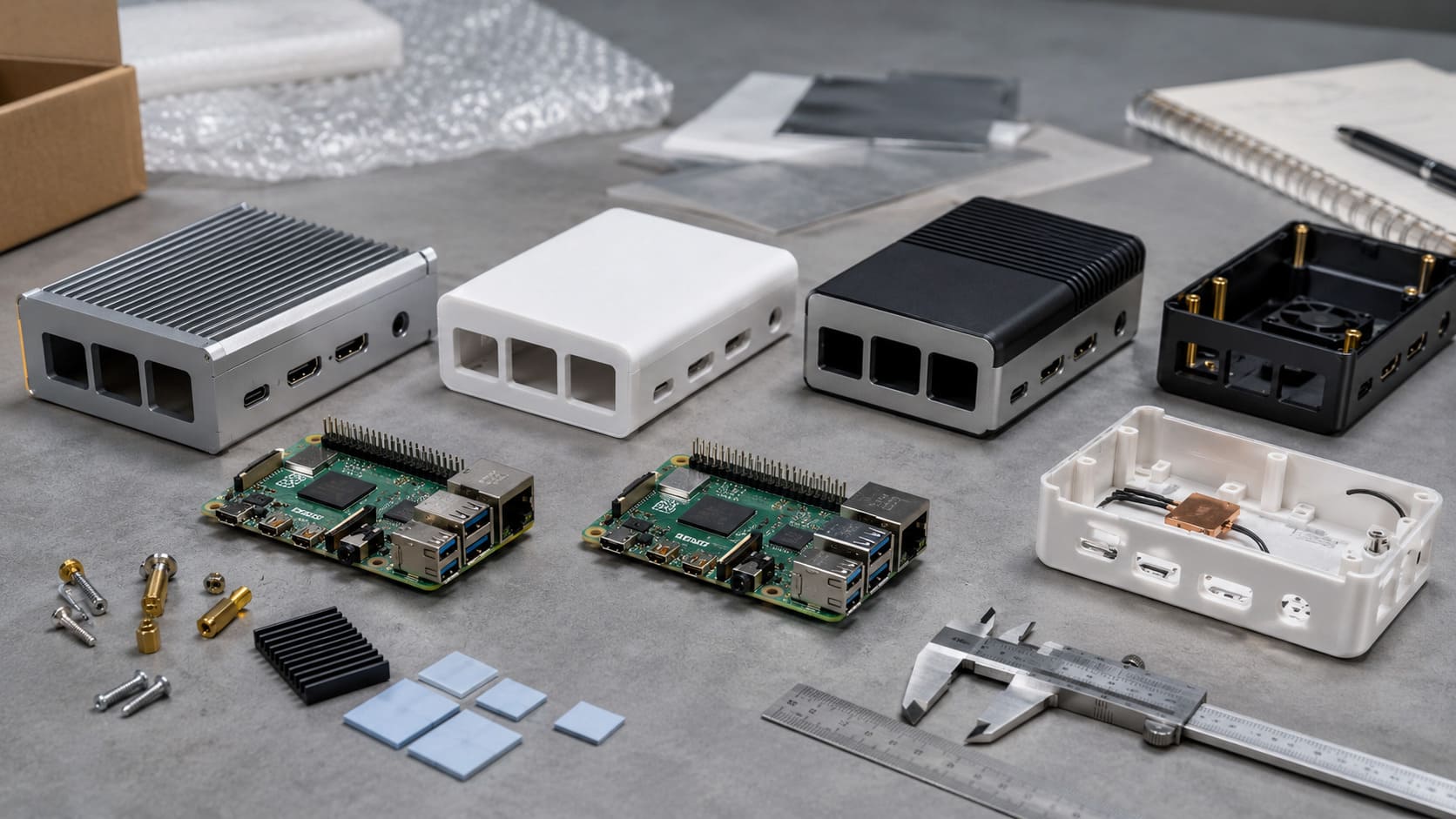
Last winter a typhoon punched the lights out in Dongguan just as I was flashing a new image on a Pi 4. My coffee went cold, but the board kept blinking on battery power. That night I learned something simple: the operating system makes the board. If the OS is clumsy, the best hardware feels slow. If the OS is lean, even a storm cannot stop your logs or your livestream.
Why the Raspberry Pi 4 Needs the Right OS
I run three production lines that burn through thousands of Pi boards each quarter. Every case, every heatsink, and every tiny cable has one job: keep the OS cool, stable, and easy to clone. Pick the wrong image and my Belgian reseller Davide calls at 3 a.m. because his Amazon stock just boot-looped. Pick the right image and nobody calls at all.
Quick Specs That Influence OS Choice
| Spec | Value | Why It Matters |
|---|---|---|
| CPU | 4 × 1.8 GHz Cortex-A72 | Some OS need 64-bit to unlock full speed |
| RAM | 2 GB – 8 GB | Heavy desktops chew RAM; headless builds don’t |
| GPU | VideoCore VI | Media OS need hardware decode for 4 K 60 fps |
| I/O | USB 3.0, GbE, dual micro-HDMI | Server images love fast USB SSDs |
Alright, we know the stakes. Let’s see what the official crew gives us before we chase shinier toys.
Officially Supported: Raspberry Pi OS
Bookworm (32-bit & 64-bit)
I flash Bookworm on every board that ships to first-time buyers. The 64-bit build breaks the old 3 GB RAM wall and handles Chromium tabs like a weekday laptop. The 32-bit image stays nimble on 2 GB units that power kiosk screens in Seoul subways.
Pros
- Tight integration with Pi firmware
- First in line for camera and GPIO updates
Cons
- Old packages compared with rolling distros
- Minimal desktop eye-candy
Legacy Bullseye for Long-Term Projects
Factories hate surprises, so I keep Bullseye images archived. They boot on revision-one boards and still accept patched kernels. If your robot arm has no screen and no human nearby, Bullseye is still fine.
Bookworm covers the basics, but some readers crave polished desktops or server muscle. Time to widen the view.
Mainstream Desktop & Server Linux

| Distro | Footprint (GB) | Desktop Ready | LTS Support | Notable Edge |
|---|---|---|---|---|
| Ubuntu 24.04 LTS | 7 | Yes | 5 years | Cloud-native snaps |
| Debian 12 “Bookworm” | 6 | Yes | 3 years | Pure upstream |
| Fedora 40 (aarch64) | 8 | Yes | 13 months | Cutting-edge kernels |
| Manjaro ARM (KDE/XFCE) | 6 | Yes | Rolling | Easy GUI installer |
| Arch Linux ARM | 2 | DIY | Rolling | “Bleeding” packages |
Ubuntu 24.04 LTS (Desktop / Server / Core)
I use the Server image for a Git runner that compiles cases’ CAD files on the fly. Snap packages feel heavy, yet Canonical’s five-year patch promise lets me sleep.
Debian 12 “Bookworm”
Debian is the silent uncle of the Pi family. Fewer surprises than Ubuntu, slower than Manjaro, but my network monitor has hit 400 days uptime on it. That speaks louder than marketing.
Fedora 40 Workstation (aarch64)
Fedora ships Wayland, PipeWire, and the latest Gnome weeks ahead of LTS distros. Great for demo kiosks; risky for embedded sensors that hate kernel jumps.
Manjaro ARM KDE / XFCE Editions
Manjaro trims Arch’s sharp edges with friendly installers. I hand this SD card to interns so they see pacman without tears.
Arch Linux ARM Rolling Release
Arch is freedom with foot-notes. Everything is current, so you must read changelogs like morning news. I reserve it for prototypes where the package I need dropped only yesterday.
Desktops are nice, yet not every board needs wallpaper. Let’s strip the fat next.
Minimal & Lightweight Builds
DietPi (Ultra-Slim Deb-Based)
Boots under 400 MB. Its menu lets me install Pi-hole or Nextcloud in three taps. Good for Davide’s headless log servers that hide in metal racks.
Alpine Linux (Musl-Based, Security-Focused)
Runs from RAM, features read-only root. Our Shenzhen sensor nodes reboot in one second flat. Edge? Documentation is thinner than Debian’s.
Gentoo Stage 3 on aarch64
You compile every package, so it feels like grinding your own flour. Performance shines, but only if you value hours at the console.
Tiny Core Linux “PiCore”
Core image is 16 MB. I use it for one job: boot a test jig that toggles GPIO pins faster than my eye blinks.
Still following? Cool. Once boards lose weight, they often crave fun or music.
Media-Center & Audio-Visual Distros

LibreELEC (Kodi Appliance)
Plug, play, popcorn. Hardware decoding for HEVC 4 K keeps CPU temp under 60 °C inside our acrylic living room case.
OSMC (Kodi + Debian Base)
Adds apt under the hood. I once installed a VPN here so our Berlin demo loop could bypass regional locks at a trade show.
Volumio (Hi-Fi Audio Streaming)
Boots to a web UI tuned for DAC hats. Lasle swears by it to show clients how ALPS knobs feel on wood-trim speakers.
Movies done. Games next—because every Pi bench ends up with a controller nearby.
Retro-Gaming Platforms
RetroPie (EmulationStation)
Community makes themes that turn booth visitors into six-year-olds again. Needs a bit of shell work to update cores.
Recalbox (Plug-and-Play Emulators)
Less tweaking, more playing. I keep it on spare SD cards for pop-up arcades during Shenzhen Maker Faire.
Batocera Linux (All-in-One Gaming Distro)
Ships with many shaders, plus Bluetooth pairing in two clicks. Downside: updates overwrite custom configs, so back up first.
Gaming sparks nostalgia, but some boards must behave like white-label appliances. Let’s dress them in work suits.
Appliance-Style & Single-Purpose OS
Home Assistant OS (Smart-Home Hub)
My own apartment lights, blinds, and AC run off a Pi 4 with Zigbee USB stick. The supervised update flow means no babysitting.
OpenMediaVault 6 (DIY NAS)
Connects USB 3.0 SSDs and serves 900 Mbps over Gigabit LAN. I built a two-drive Plex server in an afternoon.
Raspberry Pi OS Lite + Pi-hole (Network-Wide Ad-Blocking)
One-line installer, half a watt idle. Davide bundles this combo in branded kits that fly off Facebook ads.
Some users need the opposite: break systems, test exploits, or teach cyber defense. Enter the dark-arts class.
Security & Pen-Testing Options

Kali Linux ARM (Offensive Security)
Boots with over 600 tools. I once demoed a Wi-Fi audit for a European client straight from a battery pack.
Parrot OS Home/Pro for ARM
Lighter than Kali, but rolls Anonsurf for quick traffic obfuscation. Good for classrooms where students risk bricking less.
Now you have a pile of choices. Let’s sort them without a headache.
Decision Matrix: How to Choose

| Use-Case | Best OS | Why |
|---|---|---|
| First Steps / Education | Raspberry Pi OS Bookworm | Official docs, Pixel desktop |
| Desktop Work | Ubuntu 24.04 LTS | Familiar UI, Snap store |
| Headless Server | DietPi or Debian 12 | Low RAM, solid APT |
| Media Center | LibreELEC | Fast boot, 4 K decode |
| Retro Gaming | Recalbox | Setup in minutes |
| Smart Home | Home Assistant OS | Full Supervisor |
| Pen-Testing | Kali Linux ARM | Pre-loaded tools |
Define Your Primary Use-Case
Write it on paper. A clear goal trims the table above in seconds.
32-Bit vs 64-Bit Performance & RAM Limits
64-bit unlocks full memory, but 32-bit still runs fast on 2 GB boards with small caches.
Community, Documentation & Update Cadence
A busy forum saves weeks. Rolling releases push fixes fast but might break at midnight.
Hardware Acceleration & Driver Support
Check if V3D GPU or camera stack is in the kernel. Video stutters are project killers.
Storage Footprint & Read/Write Wear
Media images bloom past 8 GB. Tiny Core fits on a 1 GB card; it also spares write cycles on cheap microSD.
Decision made? Great. Let me share how I flash a hundred cards without melting USB hubs.
Installation & Maintenance Best Practices
Preparing microSD / SSD with Raspberry Pi Imager
I script the Imager CLI. Ten writers burn in parallel; coffee break equals ten fresh images.
First-Boot Configuration (SSH, Locale, Firmware)
Touch an empty ssh file, pre-seed wpa_supplicant.conf, and your board appears on LAN seconds after power-up.
Keeping the Kernel & Bootloader Up to Date
sudo rpi-eeprom-update once a month saved us from a USB boot bug that bricked warehouse dashboards for other factories.
Backup & Rollback Strategies
I clone the golden SD to an image file, store hashes, and label each batch. If an update misfires, rollback is a two-minute swap.
Systems now boot, update, and roll back. Time to wrap up and choose your path forward.
Conclusion
I treat the Pi 4 like a blank notebook. The OS is the first sentence. Pick the right one and every chapter—be it gaming, servers, or smart lights—writes itself with less friction. Match the distro to the job, keep backups tight, and your boards will serve longer than the storms that test them.
Matching Your Project Goals to the Ideal Pi 4 OS
Define goal → Check table → Flash → Test → Deploy. Simple beats shiny.
Next Steps: Testing, Benchmarking, and Scaling Up
Benchmark idle temps, run stress tests, and clone that golden image before you ship bulk orders to clients like Davide or Lasle. Your future self will thank you.