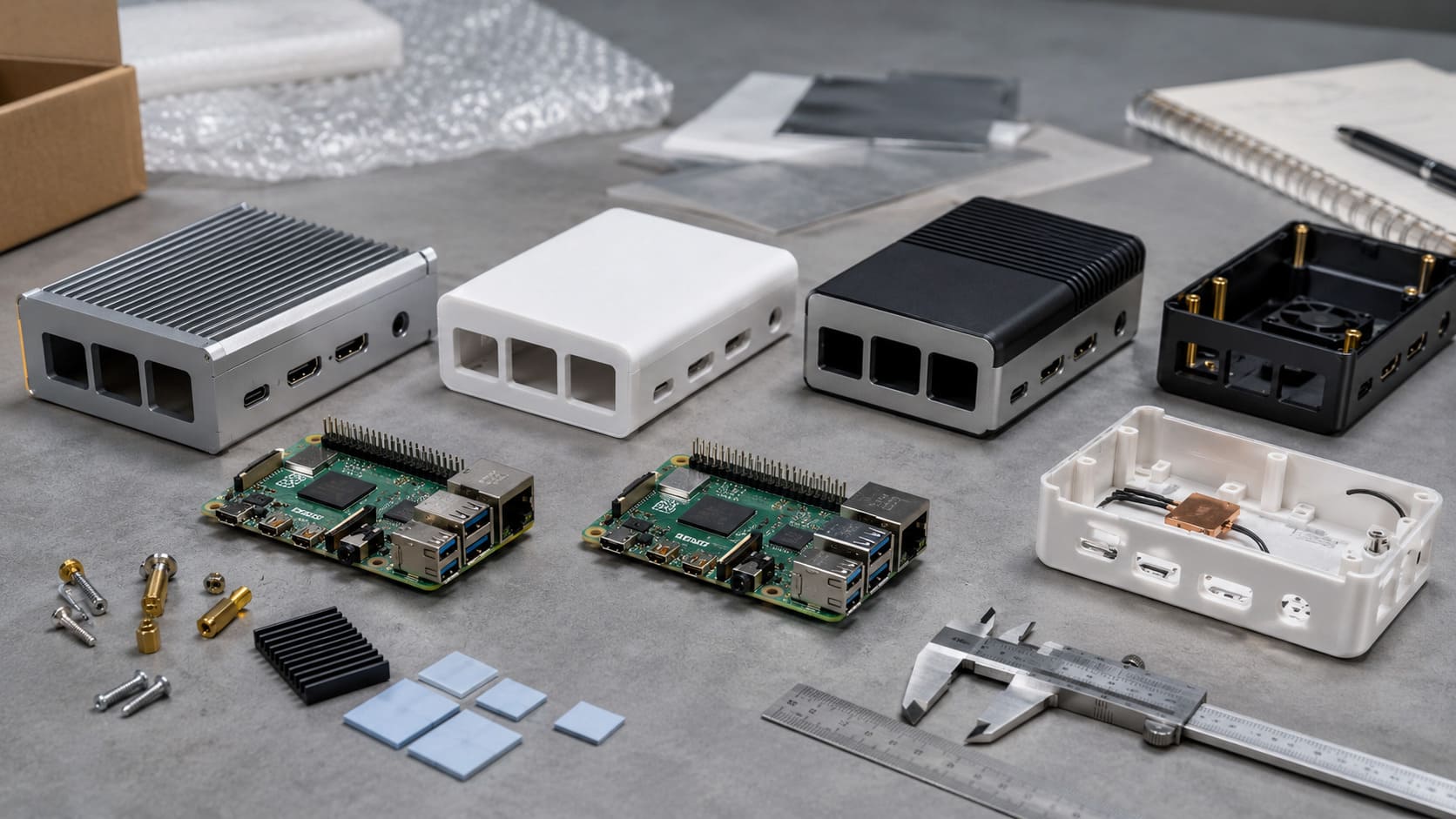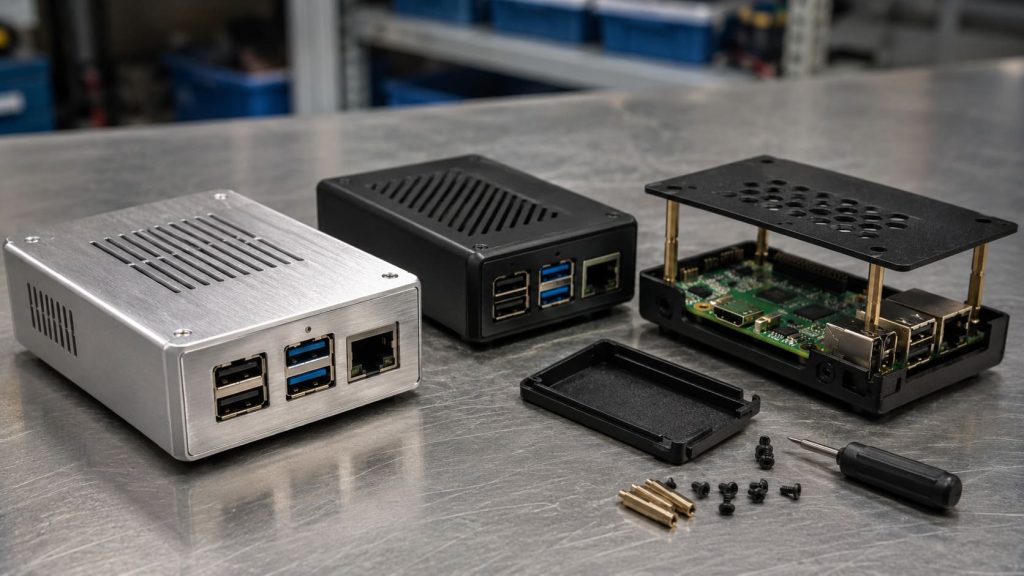
A customer once sent me a very clean product sketch for a Raspberry Pi-based wireless controller. The case was slim, black, and made from aluminum. It looked like a finished retail product before we had even produced the first sample.
The customer had already decided that aluminum was the right material.
His reasons were easy to understand.
He wanted the product to feel strong. He wanted it to look professional. He also believed that a metal case would solve any possible cooling problem. On paper, the choice looked sensible.
Then I asked one basic question:
Where is the WiFi antenna?
The answer changed the whole discussion.
The product depended on the Raspberry Pi's onboard WiFi. It had no external antenna. It also needed to work from inside a wall-mounted cabinet. Once we looked at the full application, the aluminum case stopped looking like the obvious choice.
This is a situation I see quite often.
Many Raspberry Pi users, product developers, and private-label sellers naturally prefer metal cases. Metal feels premium. It is strong. It conducts heat. It also gives a product an industrial appearance that plastic sometimes cannot match.
I manufacture and customize both metal and plastic Raspberry Pi cases, so I have no reason to argue against aluminum. We produce aluminum cases with CNC openings, anodized finishes, printed logos, engraved branding, thermal pads, and custom retail packaging.
Still, I do not recommend metal for every project.
My first concern is never whether the case looks expensive. I first ask whether the enclosure supports the way the product needs to work.
A case is not only a cover around a Raspberry Pi board. It affects the wireless signal, cooling method, product weight, assembly process, production cost, service access, and even the final selling price.
A metal Raspberry Pi case can be an excellent choice for an industrial controller, a desktop computer, or a high-load edge device. It can also be the wrong choice for a wireless sensor, a low-cost education kit, or a handheld product.
The problem is not the material itself.
The problem appears when people choose the material before they understand the application.
In this article, I will explain when a metal Raspberry Pi case may create more problems than it solves. I will also show how I compare metal and plastic when customers ask me for a custom enclosure.
1. When Is a Metal Raspberry Pi Case Not the Best Choice?
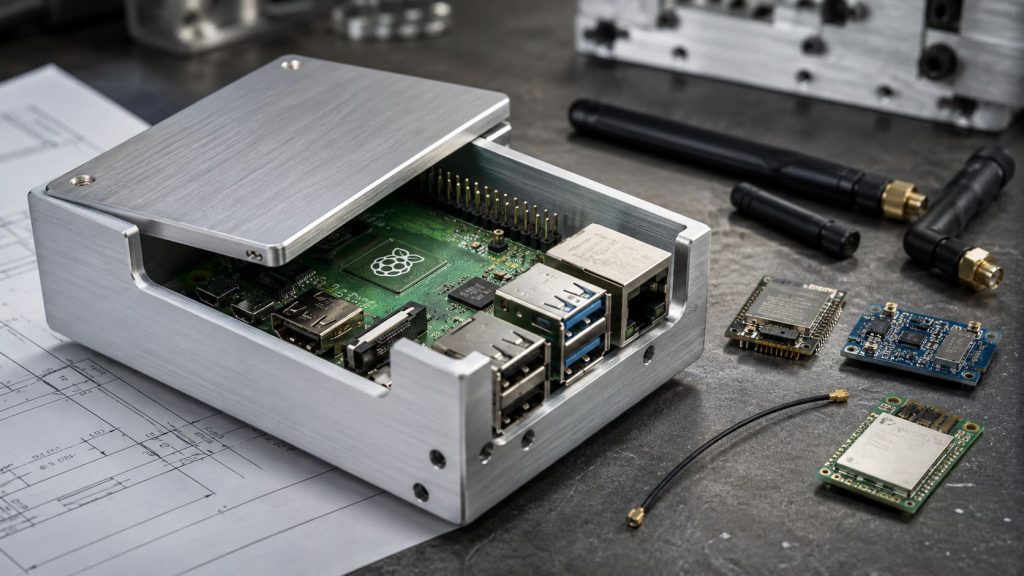
A metal case is usually presented as an upgrade. Sellers often use words such as premium, heavy-duty, and industrial-grade. Those words are attractive, but they can push buyers toward a decision before the real product needs are clear.
A stronger material does not automatically create a better product.
The right case is the one that matches the job.
1.1 A Metal Case Is Not Always Better Than a Plastic Case
Aluminum has several clear advantages.
It is stronger than common thin plastic. It can spread heat across the enclosure. It also creates a solid feeling when the user holds the product.
These benefits are real.
However, each benefit only matters when the application needs it.
For example, an industrial Raspberry Pi gateway installed beside machinery may benefit from an aluminum enclosure. The metal can protect the board from impact, support a wall-mounting structure, and provide a path for heat to move away from the processor.
A classroom coding kit has different needs.
Students may need to open the case often. Teachers may need a lightweight product that is easy to pack, carry, and replace. WiFi performance may matter more than impact resistance. A transparent plastic top may even help students see the board and understand the ports.
The same case material cannot be the best answer for both products.
| Application | What Usually Matters Most | Material I May Consider First |
|---|---|---|
| Industrial controller | Strength, mounting, heat transfer, EMC | Aluminum or sheet metal |
| Consumer smart-home device | Wireless signal, appearance, cost | ABS or PC+ABS |
| Educational kit | Low weight, easy access, low cost | ABS or acrylic |
| Portable project | Weight, battery use, impact resistance | ABS or polycarbonate |
| High-performance edge computer | Cooling, strength, long operating time | Aluminum |
| Wireless IoT sensor | RF performance, compact size, low power | Plastic |
I also look at how the product will be sold.
A private-label Amazon seller may want a metal version because it supports a higher retail price. That can make sense. However, the seller still needs to check whether customers will actually pay more for the metal body.
A project engineer may care less about the surface finish. The engineer may mainly want reliable WiFi and easy access to the GPIO pins.
A distributor may want both.
In that case, I sometimes suggest a simple product range:
- A lower-cost plastic version for standard users
- A metal version for premium users
- A cooling version for heavy workloads
- A wireless version with an external antenna opening
This gives the buyer more room to match the case to different customers.
When I review a new case request, I do not ask which material sounds better in a sales description. I ask which material removes the most risk from the finished product.
1.2 The Wrong Material Choice Can Create Engineering Problems
The enclosure affects more than appearance.
It becomes part of the engineering system.
A metal enclosure can weaken an internal wireless signal. It can increase the total weight. It may need extra insulation around the PCB. It can also require more steps during production.
A plastic enclosure has its own limits. It may not transfer heat well. It may need thicker walls for strength. It can also look less premium when the surface texture, color, or mold quality is poor.
The choice creates a group of connected trade-offs.
| Design Area | Possible Effect of Metal | Possible Effect of Plastic |
|---|---|---|
| Wireless signal | May block or weaken RF signals | Usually allows better signal transmission |
| Heat transfer | Can spread heat through the enclosure | Often needs vents, heatsinks, or a fan |
| Electrical isolation | Needs careful spacing and insulation | Naturally provides better isolation |
| Product weight | Usually heavier | Usually lighter |
| Tooling and machining | May need CNC work or extrusion tooling | May need injection mold tooling |
| Surface finish | Anodizing, powder coating, painting | Mold texture, painting, printing |
| Assembly | Can use screws and threaded holes | Can use screws, clips, or molded features |
| Product positioning | Often feels premium or industrial | Often feels light, simple, or consumer-friendly |
I have seen customers choose metal because they wanted better cooling, but the thermal pad did not touch the processor properly.
I have also seen customers choose plastic to save money, then add a fan, a large heatsink, a metal bracket, and more assembly work. The final product was no longer simple or cheap.
This is why I treat the enclosure as part of the complete design.
The Raspberry Pi model also matters. A Raspberry Pi 5 running a heavy workload has different cooling needs from a Raspberry Pi Zero 2 W collecting sensor data. A case that works well for one board may be unnecessary or unsuitable for another.
The same applies to the environment.
A desktop enclosure can use open ventilation. A factory controller may need protection from dust. A public display system may need tamper resistance. A battery-powered device may need to keep weight and power use low.
The material decision should come after these points are understood.
A case can look perfect in a 3D drawing and still cause trouble in real use. Wireless performance is one of the first places where that trouble often appears.
2. When Wireless Performance Is Critical, Metal Raspberry Pi Cases Can Be a Problem
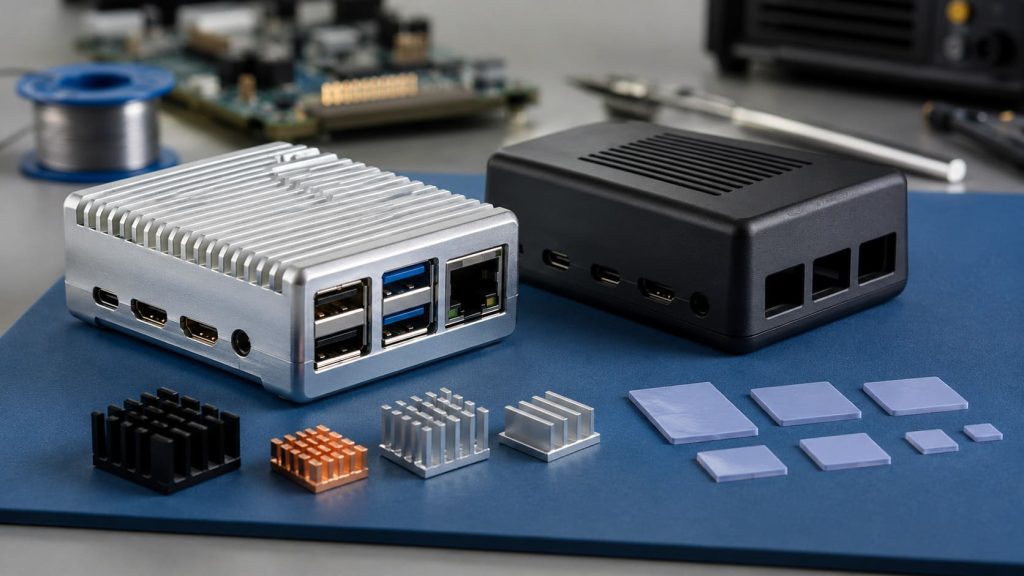
Wireless performance can be easy to overlook because it cannot be judged from a product photo.
A black anodized aluminum case may look excellent on a desk. The logo may be sharp. The machining may be accurate. The fit may be perfect.
Then the user moves the device into another room, closes a cabinet door, or places it behind a television. The WiFi connection becomes unstable.
At that point, the enclosure is no longer just a styling choice.
2.1 How Metal Enclosures Affect WiFi and Bluetooth Signals
Metal can reflect and absorb radio-frequency energy.
When a Raspberry Pi is fully surrounded by aluminum, the enclosure may act like a partial shield around the onboard antenna. People often describe this using the idea of a Faraday cage.
A real Raspberry Pi case usually has openings for USB, HDMI, power, Ethernet, and ventilation, so it is not a perfect sealed cage. However, the metal body can still reduce the strength or change the direction of the signal.
The exact effect depends on several details:
- The Raspberry Pi model
- The position of the onboard antenna
- The thickness and shape of the enclosure
- The size and location of openings
- The device orientation
- The distance from the router or Bluetooth device
- Nearby walls, cabinets, cables, and metal equipment
This makes wireless testing difficult to replace with theory alone.
A product may work well beside a router during development. It may fail after installation in the customer's real environment.
That difference matters for many applications.
Smart-home devices
A home automation controller may need to communicate through walls. A small loss in signal strength can create delayed commands or dropped connections.
IoT gateways
An IoT gateway may collect data from several wireless devices. A weak connection can reduce coverage and make the system less reliable.
Remote monitoring systems
A monitoring product may be installed in a utility room, warehouse, or outdoor cabinet. These locations can already have poor wireless coverage.
Bluetooth controllers
Bluetooth devices often work over shorter distances than WiFi. A metal enclosure can make orientation and distance more important.
The warning sign I pay attention to is not whether WiFi works on the sample table. I want to know whether it still works after the device is placed in the worst position the end user is likely to choose.
That is a more useful test.
A private-label seller also needs to think about customer behavior. End users do not always place products in ideal locations. They put devices behind monitors, under desks, inside cabinets, and beside other electronics.
A design that only works in a clean test room may create returns, bad reviews, and support problems later.
2.2 When Plastic Raspberry Pi Cases Are a Better Choice for Wireless Devices
Plastic usually allows radio signals to pass through more easily than metal.
This does not mean every plastic enclosure provides perfect wireless performance. Wall thickness, color additives, internal brackets, and nearby components can still affect the signal.
However, common enclosure plastics usually create fewer RF problems than a fully metal body.
For wireless Raspberry Pi projects, I often consider these materials:
| Material | Main Advantages | Points to Check |
|---|---|---|
| ABS | Low cost, easy to mold, good appearance | Heat resistance and flame rating |
| PC+ABS | Better heat and impact performance than standard ABS | Higher material cost |
| Polycarbonate | High impact strength, better temperature resistance | Cost and surface scratch resistance |
| Flame-retardant ABS | Better safety option for electronic devices | Confirm the exact material grade |
| Acrylic | Clear appearance and easy laser cutting | More brittle than ABS or PC |
ABS is common for consumer electronics. It is easy to color, texture, print, and mold.
PC+ABS can be a better choice when the product needs improved heat resistance or impact strength.
Polycarbonate is useful when the case needs to survive harder impacts, but the product engineer still needs to review wall thickness and molding details.
For a small prototype or low-volume project, a customer may use a standard plastic enclosure and add custom CNC openings. This can avoid the high tooling cost of a new injection mold.
For a larger production quantity, a custom injection-molded case can include:
- Internal mounting posts
- Snap-fit features
- Cable guides
- Ventilation holes
- LED light pipes
- Label areas
- Antenna clearance zones
- Custom logo details
The antenna area deserves special attention.
I usually ask for the PCB layout or at least the antenna location before confirming the enclosure structure. A plastic case helps, but the designer should still avoid placing metal screws, shields, cables, or batteries directly around the antenna.
The case may be plastic while the internal layout still creates RF trouble.
2.3 How to Improve Wireless Performance If a Metal Case Is Required
Sometimes a customer still needs metal.
The product may need an industrial appearance. It may need strong wall mounting. It may also require a metal enclosure for cooling or mechanical protection.
In that case, we do not have to abandon aluminum. We need to change the wireless design.
One common option is an external antenna.
The enclosure can include an opening for an SMA or RP-SMA connector. The antenna can then sit outside the metal housing.
This approach usually improves signal performance, but it adds parts and assembly work.
A typical external antenna design may need:
- An antenna connector
- A compatible cable
- A board or module that supports an external antenna
- A mounting hole with correct clearance
- Nut and washer access
- Cable routing inside the enclosure
- Space to avoid sharp bends
- Clear instructions for assembly
Another option is a plastic antenna window.
Part of the enclosure can use plastic while the main body remains aluminum. This allows the antenna to face an RF-transparent area.
This sounds simple, but the structure needs careful design. The plastic part must fit securely. The surface gap must look acceptable. The joint may also affect dust or water protection.
A third option is to move the antenna.
A separate antenna can be installed near an opening or inside a plastic end panel. This may work well with an extruded aluminum enclosure that uses plastic front and rear covers.
| Wireless Solution | Main Benefit | Main Trade-Off |
|---|---|---|
| External antenna | Stronger and more predictable signal | Added parts and assembly |
| Plastic antenna window | Keeps most of the metal body | More complex enclosure structure |
| Plastic end panel | Simple for extruded cases | Changes the product appearance |
| Larger case opening | Low additional part cost | May reduce protection and shielding |
| Antenna relocation | Better antenna position | Needs PCB and cable design support |
When a metal case requires three extra parts just to recover the original wireless range, I stop and compare that cost with using a plastic enclosure from the beginning.
The cheapest case is not always the lowest-cost solution.
Extra connectors, cables, inspection steps, and assembly time all affect the final cost.
Cooling decisions can create the same type of hidden complexity. Metal is often selected because of heat, but many Raspberry Pi applications do not produce enough heat to justify a full aluminum enclosure.
3. When Heat Dissipation Is Not the Main Challenge, Metal Cases May Be Overdesigned
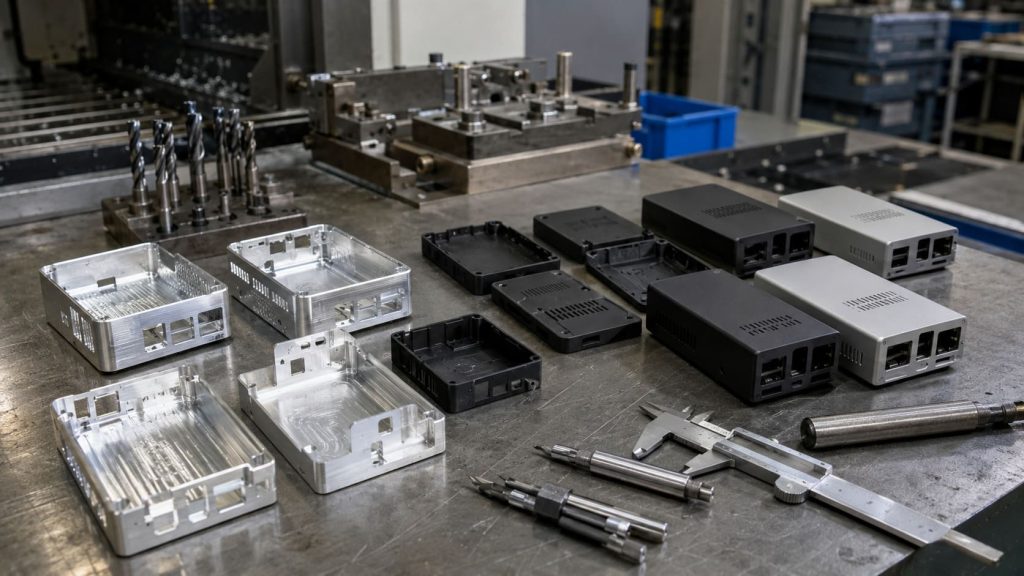
Heat is one of the strongest reasons people choose aluminum.
I understand the logic. Aluminum conducts heat much better than plastic. It can turn the enclosure into a large passive heatsink. It can also remove the need for a noisy fan.
However, a metal case only helps when the heat has a clear path from the hot component to the enclosure.
Without that path, the aluminum is just a metal box sitting near a warm processor.
3.1 Not Every Raspberry Pi Application Requires a Metal Cooling Solution
Raspberry Pi boards can become warm during operation. Newer models can generate more heat under heavy CPU loads.
Still, not every application uses the processor at full load.
A Raspberry Pi used for a basic sensor, home automation task, classroom exercise, or simple network service may spend much of its time under light load.
The thermal demand depends on several factors:
- Raspberry Pi model
- CPU and GPU workload
- Operating time
- Ambient temperature
- Software settings
- Overclocking
- Power supply quality
- Use of additional boards
- Enclosure ventilation
- Installation direction
A Raspberry Pi 5 running computer vision is not the same as a Raspberry Pi 4 controlling a simple relay.
A board inside an air-conditioned office is not the same as a board inside a sealed outdoor cabinet.
These differences matter more than the word metal.
I once reviewed a case project where the customer requested a thick aluminum top with several cooling fins. The Raspberry Pi only needed to read data from a few sensors and upload a small file every few minutes.
The cooling structure looked impressive. It also raised the case cost, increased the weight, and made the product harder to assemble.
The project did not have a heat problem. It had a fear of a possible heat problem.
That is not the same thing.
Before I approve a heavy cooling case, I look for actual temperature data under the real software load; I do not treat the highest theoretical CPU use as the normal operating condition.
The customer should test:
- Normal operating temperature
- Peak operating temperature
- Temperature during long continuous use
- Performance in the expected room or cabinet temperature
- Whether the Raspberry Pi begins to reduce performance because of heat
This gives a better base for the case design.
3.2 Passive Cooling Solutions Can Be Achieved Without Full Metal Enclosures
A full metal case is only one cooling option.
A plastic case can still support several cooling methods.
Small aluminum heatsinks
Individual heatsinks can be placed on the CPU, memory, or other hot components. This is often enough for light or medium workloads.
Cooling fans
A small fan can move air through a vented plastic case. This may provide stronger cooling than a poorly designed passive aluminum enclosure.
Fans have their own disadvantages. They create noise. They consume power. They also collect dust and can fail after long use.
Still, they may be practical for a low-cost desktop product.
Thermal pads with a metal insert
A plastic case can include a small aluminum plate or internal heatsink. A thermal pad can connect the processor to that plate.
This gives the designer local heat transfer without making the full enclosure from metal.
Ventilation design
A good vent pattern can allow warm air to leave and cooler air to enter.
The vent location matters. Random holes do not always create good airflow. The designer should think about where heat rises and where air can move.
| Cooling Method | Cost Level | Noise | Best Fit |
|---|---|---|---|
| Small heatsink | Low | None | Light to medium workloads |
| Fan inside plastic case | Low to medium | Yes | Desktop and consumer applications |
| Metal top plate | Medium | None | Compact passive cooling |
| Full aluminum heatsink case | Medium to high | None | Higher continuous loads |
| Large external heatsink | High | None | Industrial or high-load use |
A hybrid structure is often a good middle option.
For example, we can use an ABS base with an aluminum top. The plastic base supports wireless performance and electrical isolation. The metal top helps transfer heat and gives the product a more premium appearance.
This design does not suit every project, but it shows why the choice does not need to be only all metal or all plastic.
3.3 Why Thermal Design Should Start From Heat Source Analysis
Good thermal design starts with the source of the heat.
The CPU may be the main heat source, but it is not always the only one.
A Raspberry Pi product may also include:
- A power management board
- An SSD
- A cellular module
- A display driver
- A PoE board
- A battery charging module
- A custom HAT
- An internal power supply
The hottest part may not be the Raspberry Pi processor.
I ask customers for the PCB arrangement because the location of each component affects the enclosure design.
A thermal pad must have the correct thickness. If it is too thin, it will not make contact. If it is too thick, it may place stress on the board.
The contact surface must also be flat enough.
A decorative rib inside the aluminum cover may look harmless in a drawing, but it can block the thermal pad. A screw post may force the board away from the cooling surface. A tall connector may limit the space for a heatsink.
Small details decide whether the thermal design works.
The enclosure should support the cooling plan. It should not be used as a replacement for understanding the heat source.
A metal case that looks like a heatsink but does not touch the hot components can trap warm air just like a plastic case.
Heat is only one part of product cost. Once the cooling need is understood, the next question is whether the customer can recover the higher enclosure cost from the market.
4. When Cost Control Is Important, Metal Raspberry Pi Cases May Reduce Profit Margin
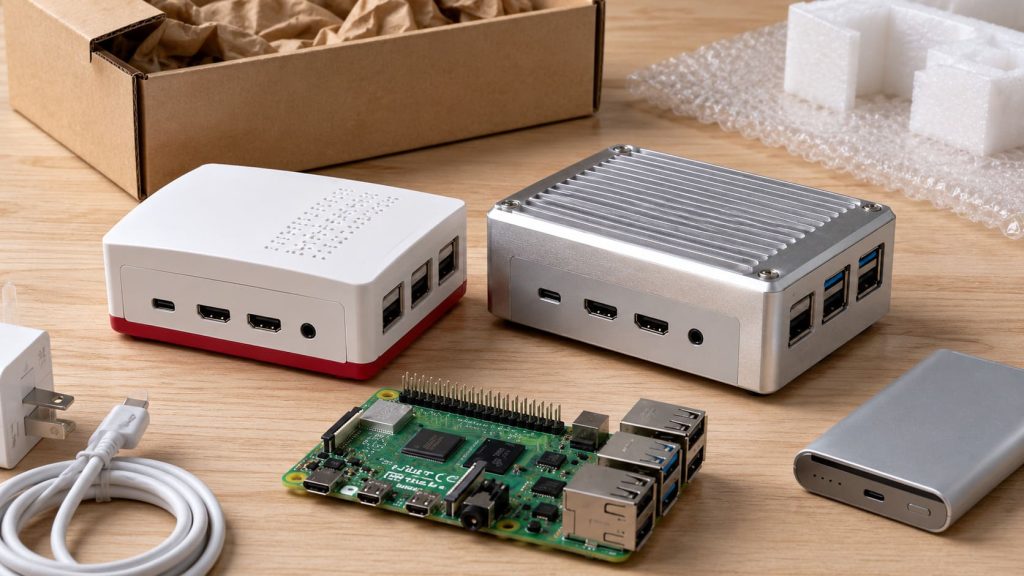
A metal case can help a product look more valuable. It can also quietly eat into the margin of a private-label seller.
The problem does not always appear in the first quotation.
It may appear after adding logo work, custom packaging, screws, thermal pads, CNC openings, and freight.
4.1 Metal Cases Usually Have Higher Manufacturing Costs
Metal enclosure cost usually comes from several processes.
For an extruded aluminum Raspberry Pi case, the production route may include:
- Aluminum extrusion
- Cutting the profile
- CNC machining
- Drilling and tapping
- Deburring
- Surface treatment
- Logo printing or engraving
- Cleaning
- Assembly
- Inspection
- Packaging
Each step adds cost and time.
A simple plastic enclosure may need fewer finishing steps after molding. However, a new injection mold can require a high starting investment.
This means the most economical material can change with the order quantity.
| Order Situation | Metal Case Cost Pattern | Plastic Case Cost Pattern |
|---|---|---|
| Very small custom batch | Can use CNC or modified standard case | Can use standard case with CNC openings |
| Medium batch | Extrusion or sheet metal may be practical | Tooling may start to make sense |
| Large batch | Unit cost may remain higher | Injection molding can reduce unit cost |
| Frequent design changes | CNC changes may be manageable | Mold changes can be expensive |
| Many color options | Surface treatment adds setup work | Color can be controlled during molding |
There is no single rule that metal is always more expensive.
A standard aluminum case with only a logo may cost less than a completely new injection-molded plastic case in a small order.
However, for high-volume consumer products, plastic often provides a lower unit cost after the mold investment has been recovered.
CNC machining is another major cost point.
Customers sometimes request openings on every side of the case. They may need USB, HDMI, Ethernet, GPIO, SD card, fan, button, LED, antenna, and power openings.
Each extra opening affects machining time, positioning, inspection, and surface protection.
The case material price may not be the largest cost. The machining can cost more.
When I see a low target price and a drawing full of small openings, I check the machining route before discussing a cheaper aluminum grade, because the labor is often the real cost problem.
That is where design simplification can help.
We may combine two openings. We may move several ports to one panel. We may use a removable end plate. We may also use an existing profile rather than opening a new extrusion tool.
4.2 Why Metal Cases May Not Be Suitable for Large Consumer Products
Consumer buyers compare prices quickly.
A customer shopping for a Raspberry Pi case on Amazon may see dozens of options within minutes. The buyer may like aluminum, but only up to a certain price.
A seller must therefore answer a difficult question:
Will the customer pay enough extra for the metal case?
A premium appearance can support a higher price, but the value must be easy to understand.
The product may need to offer:
- Better passive cooling
- Fanless operation
- Strong wall mounting
- Better protection
- Improved appearance
- A complete accessory kit
- Easier assembly
- Custom branding
- Better packaging
Metal alone may not be enough.
For a distributor, the higher buying price also increases inventory risk. The distributor must place more money into stock. If the product moves slowly, that money remains tied up.
For an Amazon seller, the heavier case can also increase shipping and fulfillment costs. The difference may look small per unit, but it becomes important over hundreds or thousands of units.
| Cost Area | Possible Impact of a Metal Case |
|---|---|
| Product purchase cost | Higher material and processing cost |
| International freight | Higher weight can increase freight |
| Fulfillment fees | Larger or heavier packaging may cost more |
| Inventory investment | More cash tied up in stock |
| Return cost | Higher-value products cost more to replace |
| Retail price | May reduce conversion if the value is unclear |
A product engineer may accept a higher case cost because reliability is the main goal.
A retailer thinks differently. The retailer must protect the selling margin.
Both views are reasonable.
The wrong decision happens when one side ignores the other.
4.3 How to Balance Product Value and Manufacturing Cost
I often suggest building the product around clear market levels.
A buyer may offer a standard plastic version and a premium metal version. This allows customers to choose based on price and performance.
Another option is a mixed-material case.
For example:
- Plastic body with an aluminum heatsink
- Plastic base with a metal top
- Aluminum extrusion with plastic end panels
- Plastic enclosure with an internal metal bracket
- Standard case with a premium branded cover
These structures can keep the main benefits while reducing cost.
The design should also match the sales channel.
An industrial buyer may care about mounting, temperature, and service life. A retail customer may care about appearance, easy assembly, and price. A school buyer may care about safety, weight, and replacement cost.
I do not think one version should be forced into every market.
A practical product range may look like this:
| Product Level | Suggested Structure | Target User |
|---|---|---|
| Entry | Vented ABS case | Students and basic users |
| Standard | Plastic case with heatsinks or fan | Home and office users |
| Premium | Aluminum case with passive cooling | Retail enthusiasts |
| Industrial | Custom metal enclosure with mounting features | OEM and automation projects |
Cost is not only about the quotation from the factory.
The buyer must also consider storage, shipping, sales price, and product returns.
Weight affects all of these points, and for portable Raspberry Pi products, it can also affect the way the user experiences the device.
5. When Lightweight Design Matters, Metal Raspberry Pi Cases May Be the Wrong Option
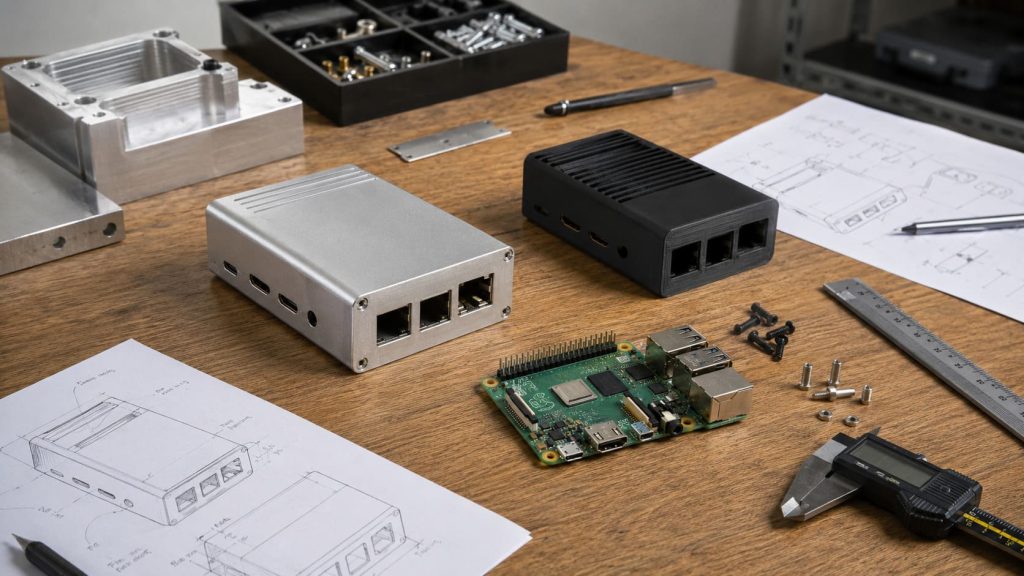
A metal case often feels reassuring in the hand. It has weight. It feels solid.
That same weight can become a problem when the product needs to move.
A desktop enclosure may stay in one place for years. A handheld tester, education kit, or battery-powered field device has a very different life.
5.1 Metal Enclosures Increase Product Weight
Aluminum is lighter than steel, but it is usually heavier than a comparable plastic enclosure.
The difference becomes larger when the metal case also includes:
- Thick walls
- Cooling fins
- Steel screws
- Mounting brackets
- Thermal blocks
- Internal metal plates
- External antennas
For a single desktop device, the added weight may not matter.
For a shipment of 1,000 units, it can affect freight.
For a handheld device, the user feels it every time the product is used.
For a wall-mounted product, the installer may need stronger screws or brackets.
For a battery-powered product, the enclosure weight adds to the weight of the battery, screen, cables, and other components.
A customer once asked us to produce a portable Raspberry Pi testing unit in a thick aluminum case. The case looked strong, but the full device became uncomfortable to hold for long periods.
The customer had focused on protection. The end user cared more about carrying the device all day.
That difference was easy to miss in the CAD file.
For a portable product, I treat every added gram as something the user must carry, not as a number that only appears on the shipping document.
The enclosure must protect the board, but it should not make the product harder to use.
5.2 Applications Where Plastic Enclosures Have Advantages
Plastic can be a better fit for several mobile applications.
Educational kits
Schools may move kits between classrooms. Teachers may pack many units in one box. A lightweight case makes storage and transport easier.
Plastic also reduces the risk of metal surfaces scratching desks or other equipment.
Handheld devices
A handheld Raspberry Pi controller should feel comfortable. Plastic can provide rounded corners, textured grip areas, and shaped surfaces more easily through injection molding.
Battery-powered products
Battery-powered devices already carry extra weight. A plastic housing can help keep the total product lighter.
Plastic also provides natural electrical isolation around batteries and charging circuits.
Mobile IoT products
Portable data loggers, mobile sensors, and temporary monitoring devices may be installed and removed often. Low weight can make the product easier to mount and carry.
| Application | Why Low Weight Matters |
|---|---|
| Classroom kit | Easier storage and transport |
| Handheld controller | Better comfort during long use |
| Battery-powered device | Lower total carrying weight |
| Drone or robot | Lower load and energy use |
| Portable test equipment | Easier field use |
| Temporary IoT sensor | Easier mounting and removal |
Plastic also gives more freedom in shape.
A molded case can include curved surfaces, grips, clips, hooks, battery doors, and cable guides. These details can make the product more useful.
A CNC-machined aluminum case can also include complex shapes, but the machining cost may become too high for a consumer product.
5.3 Choosing the Right Balance Between Strength and Weight
Plastic does not always mean weak.
Material grade and structural design make a large difference.
ABS is common because it offers a useful balance of cost, strength, appearance, and processing.
Polycarbonate provides higher impact resistance. PC+ABS combines some benefits of both materials.
Ribs, wall thickness, corner design, and screw-post structure can improve strength without adding too much weight.
A poorly designed thick plastic wall can still crack or deform. A well-designed thinner wall with support ribs can perform better.
The same idea applies to metal.
A thick aluminum block may be strong, but it may be far more than the product needs. A thinner sheet-metal structure with bends and flanges may provide enough strength at a lower weight.
| Design Method | How It Improves Strength |
|---|---|
| Internal ribs | Supports large plastic surfaces |
| Rounded corners | Reduces stress concentration |
| Reinforced screw posts | Improves repeated assembly |
| Folded sheet-metal edges | Adds stiffness without thick material |
| Local metal brackets | Strengthens only the needed area |
| Rubber bumpers | Reduces impact damage |
I prefer to strengthen the areas that carry real loads.
For example, a wall-mounting point may need reinforcement. The entire enclosure may not need thicker walls.
A connector area may need a metal bracket. The full case may not need to be aluminum.
This local approach often gives a better balance.
Product development speed creates another balance. Metal can be easy to machine for early samples, but it can also involve many finishing steps. Plastic may offer faster changes when the correct production method is chosen.
6. When Fast Development and Customization Are Required, Plastic May Be More Practical
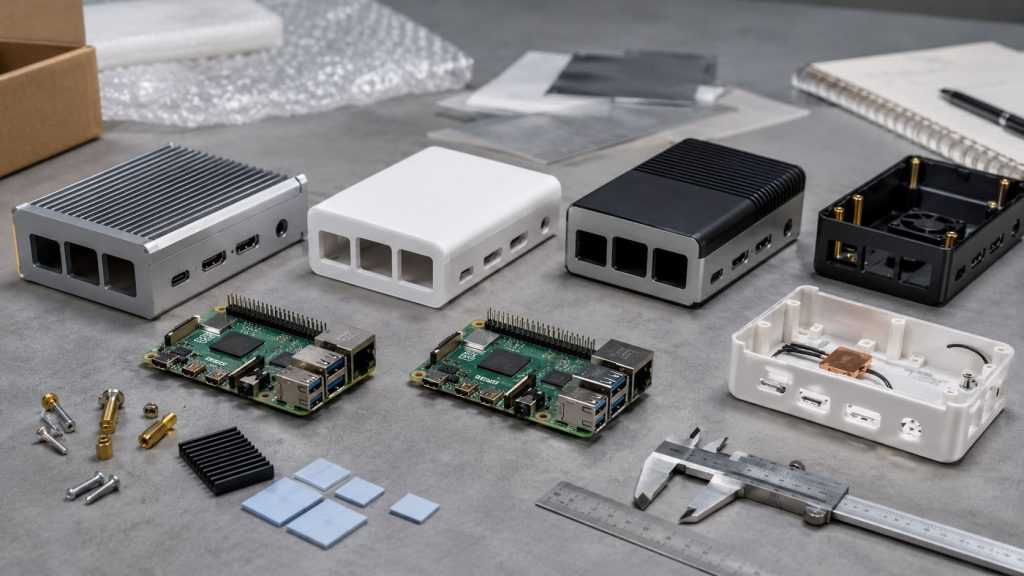
Custom projects rarely stay unchanged from the first drawing.
A connector moves. A button becomes larger. The customer adds a fan. The PCB height changes. A new cable needs more space.
These changes are normal.
The case material and production method decide how painful each change becomes.
6.1 Metal Raspberry Pi Cases Often Require More Manufacturing Processes
A custom aluminum case can involve several separate suppliers or production areas.
The profile may be extruded first. The parts are then cut, machined, deburred, cleaned, anodized, printed, inspected, and assembled.
A sheet-metal case may require:
- Laser cutting
- Punching
- Bending
- Welding
- Grinding
- Powder coating
- Printing
- Hardware installation
Each process has its own setup requirements.
A small design change can affect more than one step.
For example, moving an HDMI opening may require a new CNC program. Changing a folded panel may affect the flat pattern and bending process. Changing the surface color may need a new powder-coating batch.
Metal is still very useful for prototypes because CNC machining does not always need a large mold investment.
However, the lead time can increase when the project needs a special finish or many machining operations.
| Change Request | Possible Impact on Metal Production |
|---|---|
| Move a connector opening | New CNC or laser-cutting program |
| Add a threaded hole | Extra machining and inspection |
| Change enclosure length | New cutting setup or extrusion review |
| Change color | New anodizing or coating batch |
| Add an internal bracket | New part and assembly step |
| Change logo | New printing film or engraving file |
When a customer is still changing the PCB every week, I avoid locking the enclosure into an expensive finish too early, because one small port change can make a beautiful batch unusable.
For early prototypes, I may recommend:
- Natural aluminum without final anodizing
- A standard enclosure with CNC openings
- A simple plastic project box
- 3D-printed parts for fit testing
- Laser-cut acrylic for layout testing
- A low-quantity sample before production
The goal is to learn before spending more money.
6.2 Why Plastic Enclosures Can Be Better for Rapid Product Development
Plastic offers several development routes.
For very low quantities, a customer can use a standard ABS enclosure and machine custom openings.
For appearance testing, 3D printing can help confirm size, shape, and assembly.
For larger quantities, injection molding can create complex features in one part.
The advantage of plastic is not always speed. A new injection mold can take time to design, produce, test, and modify.
The advantage is design freedom.
A molded plastic case can include details that would require several separate metal parts:
- Snap hooks
- PCB posts
- Cable clips
- Battery compartments
- Light pipes
- Vent patterns
- Curved surfaces
- Finger grips
- Hidden screws
- Branding areas
This can reduce assembly work after the mold is complete.
Plastic is also easier to use for unusual consumer shapes. A rounded smart-home controller may look natural in molded plastic. The same shape in aluminum may require expensive CNC machining.
For startup and ODM projects, I often divide development into stages.
Stage 1: Functional test
The customer uses a standard box, 3D-printed case, or simple CNC sample.
The goal is to test the PCB, ports, wireless signal, and heat.
Stage 2: Engineering sample
We improve the mounting, tolerances, screw positions, ventilation, and assembly.
The goal is to confirm the structure.
Stage 3: Appearance sample
We confirm the color, texture, logo, and packaging.
The goal is to prepare for customer approval and marketing.
Stage 4: Production design
We finalize the mold, machining drawings, quality standard, and packing method.
The goal is stable production.
This staged approach reduces the risk of paying for tooling before the product is ready.
6.3 How OEM Customers Should Select Materials During Development
I do not begin material selection with the question, “Do you prefer metal or plastic?”
I begin with the product.
I ask:
- Is it an industrial or consumer product?
- Will it use onboard WiFi or Bluetooth?
- Will it run continuously?
- What is the main heat source?
- Will the user hold or carry it?
- Does it need wall, DIN rail, or VESA mounting?
- How often will the case be opened?
- What is the expected order quantity?
- What is the target selling price?
- Does the product need a premium retail appearance?
- Does it need dust or water protection?
- Does it have EMC requirements?
The answers often make the material choice clearer.
| Project Condition | Possible Direction |
|---|---|
| Low quantity and frequent changes | Standard case with custom machining |
| High quantity consumer product | Custom molded plastic |
| Heavy processor load | Aluminum heatsink case |
| Internal wireless antenna | Plastic or antenna window |
| Harsh industrial environment | Metal with proper grounding and sealing |
| Portable application | Lightweight plastic or hybrid case |
| Premium retail product | Anodized aluminum or high-quality molded plastic |
The customer should also think about future models.
A custom enclosure may need to support a new Raspberry Pi version, a different connector layout, or another internal board.
A modular structure can help.
For example, a common enclosure body can use different front panels. This allows the buyer to change ports without redesigning the full case.
Plastic end panels on an aluminum extrusion can also support different versions.
A removable I/O plate may make upgrades easier.
Fast development is not only about producing the first sample quickly. It is about making later changes without starting again.
Material decisions also affect EMC and electrical isolation. Metal can help with shielding, but it can create a false sense of safety when grounding and panel design are poor.
7. When EMC and Electrical Isolation Requirements Matter, Metal May Require Extra Design Consideration
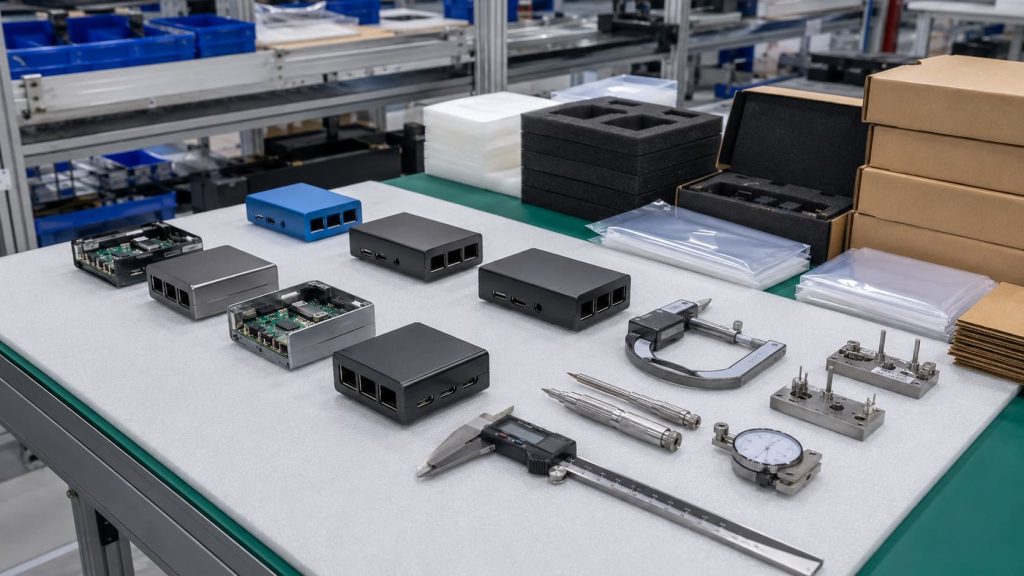
Metal is often selected for EMC protection.
That can be the right choice.
A conductive enclosure can help reduce electromagnetic interference. It can also protect sensitive electronics from outside noise.
However, an aluminum box does not automatically create a complete EMC solution.
The seams, openings, cables, coating, grounding, and PCB layout still matter.
7.1 The Advantages of Metal Enclosures for EMC Protection
A metal enclosure can create a conductive barrier around electronic components.
This can help in two directions:
- It can reduce unwanted electromagnetic energy leaving the device.
- It can reduce unwanted electromagnetic energy entering the device.
This is useful for industrial controllers, automation equipment, communication devices, test systems, and products installed near motors or switching power supplies.
Metal can also provide a grounding path.
When designed correctly, the enclosure can connect to protective earth or circuit ground. This may improve shielding and electrical safety.
The exact grounding method depends on the product and applicable requirements.
A metal case can be especially useful when the Raspberry Pi product includes:
- High-speed digital interfaces
- Cellular modules
- Switching power supplies
- Long cables
- Motor controls
- Industrial communication ports
- Sensitive analog circuits
Still, the enclosure must be part of the complete EMC design.
A large opening for HDMI, Ethernet, or a fan can reduce shielding.
A painted panel may not make electrical contact with the main body.
An anodized aluminum surface is not automatically a good conductive contact surface because the oxide layer can act as an insulator.
These small details matter.
7.2 Why Metal Does Not Automatically Guarantee EMC Compliance
I sometimes receive requests that simply say, “The case must be aluminum for EMC.”
That sentence is not enough.
I need to know how the panels connect, how cables enter, and how the board is grounded.
An enclosure with several loose panels and large gaps may provide poor shielding even when every part is made from metal.
A good EMC design may require:
- Conductive contact between panels
- Bare metal contact areas
- Grounding points
- EMC gaskets
- Shielded cables
- Filtered connectors
- Proper cable entry
- Small and controlled openings
- Correct PCB grounding
- Separation between noisy and sensitive circuits
| Design Detail | Why It Matters |
|---|---|
| Panel seams | Gaps can allow electromagnetic energy to pass |
| Surface coating | Paint or anodizing may block electrical contact |
| Cable openings | Cables can carry noise into or out of the enclosure |
| Grounding point | Poor grounding can reduce shielding performance |
| Vent holes | Large openings can reduce enclosure shielding |
| PCB layout | The case cannot correct every internal EMC problem |
| Connector type | Shielded connectors may improve overall performance |
When someone tells me that the aluminum body alone will solve EMC, I inspect the seams and cable entries first, because those weak points usually decide the real result.
The PCB layout is also critical.
A noisy power circuit beside a sensitive antenna can create problems inside any enclosure.
A long ground path can reduce shielding performance.
A cable shield connected incorrectly may act like an antenna instead of protection.
The enclosure cannot repair every internal design mistake.
This is why final products may need proper EMC testing. The case material is only one part of the result.
7.3 When Plastic Enclosures Can Still Meet EMC Requirements
Plastic provides electrical isolation and good wireless performance, but it does not naturally provide the same shielding as metal.
Still, plastic enclosures can use added shielding methods.
One method is conductive coating.
The inside of the plastic enclosure can be coated with a conductive material. This creates a shielding layer while keeping the outside plastic appearance.
Another method is an internal metal shield.
A metal cover can protect only the sensitive or noisy area of the PCB. This may be enough when full enclosure shielding is unnecessary.
Conductive films, foils, and gaskets can also be used in some designs.
| Plastic EMC Solution | Main Advantage | Main Limitation |
|---|---|---|
| Conductive internal coating | Keeps plastic exterior and adds shielding | Adds process and inspection cost |
| Internal metal shield | Protects a local circuit area | Does not shield the full product |
| Conductive foil | Useful for prototypes or selected areas | Assembly consistency may be difficult |
| Shielded cable and connector | Controls noise through cable paths | Does not solve all enclosure emissions |
| PCB-level shielding can | Compact and focused protection | Needs space and board design support |
A plastic enclosure may therefore be suitable when the product needs both wireless communication and limited EMC control.
For example, the designer can shield the power section while leaving the antenna area clear.
This selective approach can work better than surrounding the full product with metal and then trying to recover the lost wireless signal.
Electrical isolation is another advantage of plastic.
A metal case needs careful clearance around the board, exposed solder points, batteries, and power terminals. Insulating sheets, spacers, or plastic supports may be needed.
Plastic reduces some of these risks naturally, although the product still needs proper electrical design.
Once wireless, heat, cost, weight, production, and EMC have been considered together, the material decision becomes much easier.
8. How to Decide Between Metal and Plastic Raspberry Pi Cases
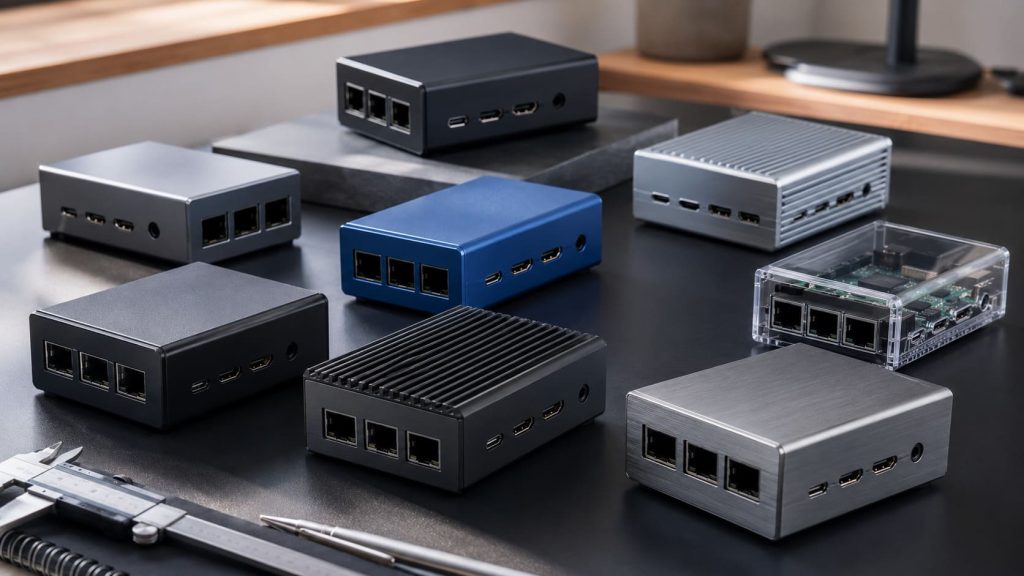
By this point, metal may sound difficult.
That is not my message.
Metal remains one of the best choices for many Raspberry Pi products. I only believe it should earn its place in the design.
The same rule applies to plastic.
8.1 Questions to Ask Before Choosing a Raspberry Pi Case Material
I use a simple group of questions when reviewing a new project.
What is the application environment?
I ask whether the product will sit on a desk, hang on a wall, operate inside a machine, or travel with the user.
I also ask about dust, moisture, vibration, sunlight, temperature, and impact risk.
Does the product require WiFi or Bluetooth?
If the answer is yes, I ask whether the product uses the onboard antenna or an external one.
I also ask where the end user will install the device.
How much heat does the product generate?
I look at the Raspberry Pi model, software load, other heat sources, and operating time.
I prefer test data when it is available.
What is the expected order quantity?
A production method that works for 50 units may not be economical for 10,000 units.
Quantity affects tooling, machining, assembly, and unit cost.
What is the target selling price?
The enclosure should support the customer's business model.
A beautiful case that leaves no margin is not a successful design.
Is the product industrial or consumer-facing?
Industrial products may value strength, mounting, and service life.
Consumer products may value low weight, wireless performance, shape, color, and retail price.
How often will the enclosure be opened?
A development board case may be opened often. A finished controller may remain closed for years.
This affects screw choice, clip design, access panels, and material strength.
What future changes are expected?
A customer may later add a display, fan, antenna, SSD, or new PCB.
A modular enclosure can make these updates easier.
My final material choice usually comes from the feature that cannot be compromised, not from the longest list of nice-to-have benefits.
Every project has one or two requirements that matter most.
For one project, that may be wireless range.
For another, it may be passive cooling.
For another, it may be a target retail price that cannot be exceeded.
8.2 Simple Comparison: Metal vs Plastic Raspberry Pi Cases
The following table gives a general comparison. The real result still depends on the exact design.
| Requirement | Metal Case | Plastic Case |
|---|---|---|
| Heat dissipation | Usually better when thermal contact is designed correctly | Depends on ventilation, heatsinks, or fans |
| Wireless performance | May need an external antenna or plastic RF area | Usually better for internal antennas |
| Mechanical strength | Strong and rigid | Depends on material, wall thickness, and ribs |
| Product weight | Usually heavier | Usually lighter |
| Electrical isolation | Needs careful spacing and insulation | Naturally better |
| EMC shielding | Better starting point | Needs added shielding when required |
| Low-volume customization | Good with CNC machining | Good with standard boxes or 3D printing |
| High-volume unit cost | Can remain relatively high | Can become lower after mold investment |
| Premium appearance | Anodizing and metal texture work well | High-quality molding can also look premium |
| Complex shapes | Often expensive to machine | Easier with injection molding |
| Port changes | Panels can sometimes be machined again | Mold changes may be expensive |
| Surface options | Anodizing, powder coating, painting | Mold color, texture, painting, printing |
| Recycling and material separation | Metal body is easy to identify | Depends on plastic type and product assembly |
| Portable use | May be too heavy | Often more suitable |
| Industrial mounting | Strong threaded and bracket options | May need inserts or reinforcement |
There are also many hybrid choices.
I do not limit the design to two boxes marked metal and plastic.
A useful final structure may include:
- Aluminum main body with plastic end panels
- ABS body with an aluminum cooling plate
- Plastic cover with an internal steel bracket
- Metal enclosure with an external antenna
- Plastic enclosure with conductive coating
- Sheet-metal base with a plastic top
- Standard extrusion with custom removable panels
Hybrid designs can solve several problems at the same time.
However, they can also add more parts. More parts mean more tooling, more suppliers, more assembly, and more possible quality problems.
The hybrid design should therefore have a clear reason.
8.3 Why Working With an Experienced Raspberry Pi Case Manufacturer Helps
A case supplier should do more than quote the size and color.
The supplier should ask how the product works.
When customers send us a Raspberry Pi enclosure project, I usually request as much practical information as possible:
- Raspberry Pi model
- PCB drawing or layout
- Port positions
- Overall size limit
- Installation method
- Cooling requirement
- Wireless requirement
- Order quantity
- Target cost
- Logo file
- Packaging requirement
- Expected operating environment
This helps us compare existing cases, modified standard cases, and fully custom designs.
Sometimes an existing aluminum profile can be changed with new CNC openings.
Sometimes a standard plastic enclosure is enough.
Sometimes a completely new mold is justified.
Sometimes I recommend changing the enclosure material before we quote.
That last answer may not create the largest order for us, but it can prevent the customer from building the wrong product.
A good supplier should also help with practical details such as:
- Thermal pad thickness
- Screw length
- PCB mounting height
- Connector clearance
- Surface treatment
- Logo method
- Packaging protection
- Assembly order
- Sample testing
- Quality inspection points
For private-label customers, the supplier should consider retail details.
The logo must be placed correctly. The case surface should be protected during shipping. Screws and accessories should be packed clearly. Labels should match the correct model. The carton quantity should support warehouse handling.
For ODM customers, engineering communication matters even more.
The supplier should identify conflicts before production, not after the goods are finished.
A drawing may show a screw directly below the PCB. A thermal pad may cover a small component. A fan may block the GPIO cable. An antenna cable may have no safe route.
These are small problems in the drawing stage. They become expensive problems in production.
Conclusion: A Metal Raspberry Pi Case Is a Tool, Not Always the Best Solution
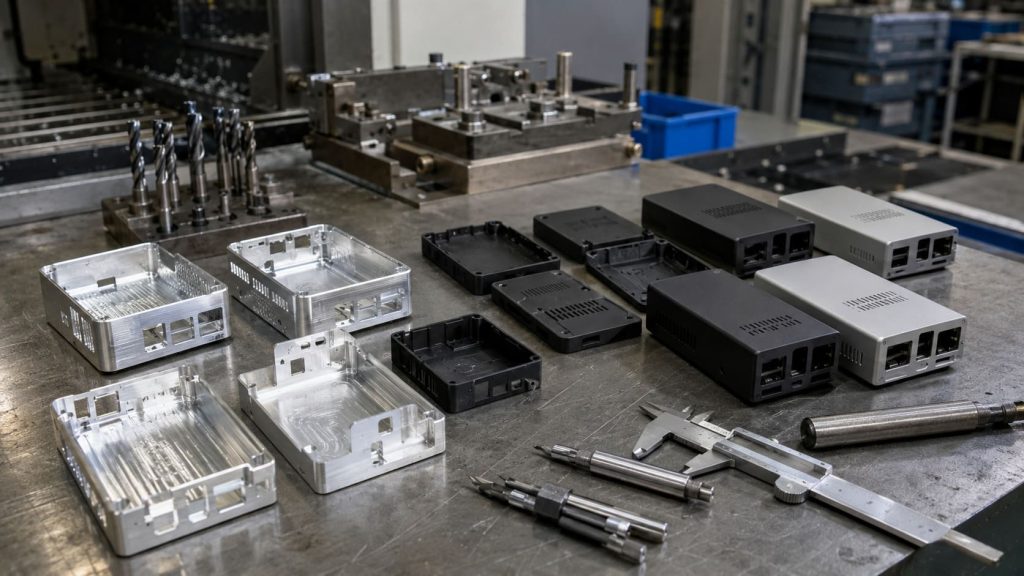
I do not avoid metal Raspberry Pi cases.
We manufacture them. I like their solid feel, clean appearance, and passive cooling ability. A well-designed anodized aluminum case can turn a development board into a professional finished product.
I also know where metal creates problems.
It can weaken WiFi and Bluetooth. It can add weight. It can increase machining and finishing costs. It can complicate electrical isolation. It can also give customers false confidence about cooling or EMC.
I reached this view after seeing the same pattern in different projects.
A customer begins with a material choice because the material looks professional. The customer then tries to force the wireless, thermal, structural, and cost requirements into that choice.
I prefer the opposite process.
I begin with how the product will be used.
I look at the environment, workload, antenna, ports, installation, quantity, target price, and user behavior. After that, I select the enclosure structure.
Sometimes the answer is a full aluminum case.
Sometimes it is ABS.
Sometimes it is PC+ABS.
Sometimes the best answer sits between them: a plastic body with a metal cooling plate, or an aluminum extrusion with plastic end panels.
I believe the best Raspberry Pi case is not the one with the most expensive material. It is the one that removes the right problems without creating new ones.
This is why I sometimes tell a customer that metal is the wrong choice, even when our factory can produce it.
A successful enclosure should help the product work better. It should also make production, assembly, shipping, selling, and maintenance easier.
At MaidaTech, we support custom aluminum cases, plastic enclosures, modified standard cases, private-label products, and OEM or ODM Raspberry Pi projects. We can also provide custom logos, engraving, labels, accessories, and retail packaging.
If you are developing a Raspberry Pi product and are unsure whether to use metal or plastic, send me your board layout, application details, expected quantity, and basic case requirements.
I will help you compare the options based on how the product needs to work—not only on how the case needs to look.